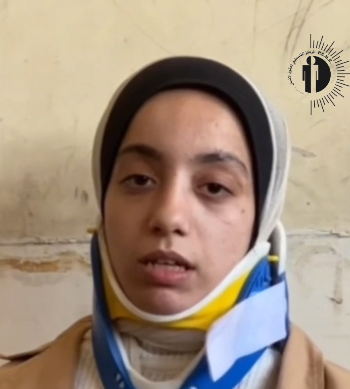
My name is Mayar Akram Shehdah Al-Shakhbir. I am 20 years old and a resident of the Beit Lahia Housing Project in the northern Gaza Strip.
I am the only survivor of the Al-Malfouh family massacre in the Al-Qassasin area.
We had been displaced from the Beit Lahia Housing Project to my uncle’s house in the Al-Qassasin area. We were besieged there when the Israeli occupation forces (IOF) broke into the house without any warning.
After forcing us out of the rooms, the soldiers told us there would be no food, no water, and no access to a bathroom. We were held in a small room and subjected to the worst insults.
They then took the young men, including my blind uncle. Although we repeatedly told them that he was blind, they insisted on taking him. They dragged him outside with the others and tortured them. We could hear them moaning in pain.
We cried and kept calling, “Mahmoud… Mahmoud.” The soldiers told us to be quiet and claimed that Mahmoud was fine.
They fired their weapons around us, opened the valve of the gas cylinder, and locked us inside the house. They photographed each of us individually and then took a group photo.
They also took around 7,000 shekels that belonged to my blind uncle. They burned the money in front of us while mocking us and singing, “Where are the millions? Where are the Arab people?”
Before leaving, they brought my 58-year-old uncle, Emad Al-Malfouh. He was naked, and his hands were tied and swollen from severe torture.
Before untying his hands, one of the soldiers took a sharp tool from his pocket and began slashing my uncle’s body. He was bleeding while we cried. My uncle told us, “If they kill me in front of you, do not say a word. At least you may survive.”
Jad is my blind uncle, while Emad is the uncle who was tortured in front of us.
A soldier forcefully grabbed my blind uncle by his shirt while we kept telling them he was blind. The soldier shouted at us to be quiet. They dragged him across the ground, forced him to kneel as they had done to us, pressed the muzzle of a weapon against his back, stripped them, threw them outside, and tied their hands.
We did not know what they were doing to them. We could only hear them screaming outside.
Before leaving, the soldiers ordered us not to leave the house. They threatened to shoot us if we did, saying they would be stationed nearby at the Al-Shrafi family house.
That night, we tried to sleep. Around 3:00 a.m., we woke up to the voices of my uncle Nehad and my brother Mahmoud, along with people screaming in the street and knocking on our door.
When we opened the door, they came inside. Their bodies were covered in bruises from the beatings, and their hands were tied and swollen.
The soldiers had told them not to leave because the area had become safe. My uncles went to take a shower, but my mother said that we would leave the following morning regardless of what the soldiers had told us.
We went back to sleep, and then the house was bombed without any warning. No one called us or warned us beforehand.
There were 21 people sleeping in the house, including 10 children. The others were adults and elderly family members, including my 72-year-old grandmother and my 48-year-old mother.
I woke up buried under the rubble. I heard my uncle’s wife calling out, so I begged her to pull me out and not leave me to die.
She replied, “I can’t.”
I told her, “I am still alive. I am still breathing. Please get me out of here.”
As she was about to leave, I heard her daughter say, “Mom, please help her. Don’t leave her to die.”
I asked for some water, but she said, “I can’t pull you out to give you water.”
As I lay trapped beneath the rubble, I began drinking the blood running down my face because I was bleeding.
I sustained burns and injuries to my face. I received stitches from my head down to my neck. I also suffered fractures in my back and shoulder, along with burns on my back and legs.
That is my whole story.
Later, I learned that my entire family had been killed. I was not told everything at once; the news was given to me gradually. They told me to pray for my family because they were all gone.
Eighteen members of my family were killed: my mother, two sisters, four brothers, my uncles, one of my uncles’ wives, my grandmother, and my cousin. My married sister was also killed, along with her husband and their daughter.