More than two million Palestinians are living in a severe health and environmental catastrophe resulting from the accumulation of hundreds of thousands of tons of solid waste within residential areas, shelters, and displacement tents scattered across the streets, as well as the leakage of wastewater and the widespread proliferation of rodents and insects. These conditions threaten people’s lives and health and add a new dimension to their worsening humanitarian suffering. This health and environmental catastrophe cannot be separated from the policies and measures imposed by the Israeli Occupation Forces (IOF) over the past 32 months in the Gaza Strip, which continue to this day despite the declaration of a ceasefire on 10 October 2025. More than two million Palestinians remain confined to only 30% of the Strip’s total area and are deprived of any meaningful recovery or rehabilitation of civilian infrastructure due to the ongoing ban on the entry of essential materials, particularly construction supplies such as cement.
This coincides with the ongoing systematic destruction of infrastructure, the prohibition of the entry of equipment and machinery necessary for rubble removal and waste collection, the obstruction of fuel supplies required for the operation of municipal services, and the prevention of repairs to water and wastewater networks, as well as restrictions on the entry of materials needed to combat rodents and insects. These measures directly contribute to the creation of an environment that endangers the basic necessities of human life. These practices constitute serious violations of Articles 55 and 56 of the Fourth Geneva Convention, which oblige the occupying power to ensure public health and to take preventive measures necessary to combat the spread of diseases and epidemics among the civilian population.
The ongoing confinement of more than two million Palestinians in a limited area, amid the spread of waste, wastewater leakage, and the proliferation of rodents and insects, forms only part of the deadly living conditions imposed systematically and continuously on the civilian population, including the deprivation of the bare minimum essentials for survival and public health. These conditions correspond to the concept of deliberately inflicting on a group conditions of life calculated to bring about its physical destruction in whole or in part, as set out in Article II(c) of the Convention on the Prevention and Punishment of the Crime of Genocide. The maintenance of such policies despite repeated warnings by the United Nations and humanitarian organizations regarding the risk of outbreaks of deadly diseases and epidemics, and the failure to take necessary measures to prevent the worsening of the crisis, constitute a highly significant indicator in assessing the presence of the special intent required under international law for the crime of genocide.
According to PCHR’s follow-up, the extensive destruction of infrastructure, municipal buildings, waste management facilities, and landfills, in addition to the shortage of fuel necessary for the operation of wastewater and waste transfer vehicles, has led to an almost complete inability to collect and safely dispose of solid waste. As a result, waste is accumulating in residential areas, near shelters, and between tents in streets and markets, creating conditions conducive to the outbreak of epidemics.
Engineer Tareq al-Habbash1, Executive Director of the Joint Services Council for Solid Waste Management in Khan Younis, Rafah, and the Central Gaza Strip, stated to PCHR’s researchers that since the first day of the war on 7 October 2023, IOF have prevented access to the main landfills, foremost among them al-Fukhari landfill for the southern Gaza Strip and Juhor ad-Dik landfill serving Gaza City and the northern Gaza Strip. Al-Fukhari landfill receives waste from 17 municipalities, with quantities ranging between 600 and 650 tons per day. The Council resorted to an alternative plan whereby each municipality designated a temporary site for waste collection. However, the continued long-term denial of access to the main landfills has created a severe situation marked by the spread of random dumps that pose significant environmental risks, particularly as these sites are open and lack fences, gates, rainwater drainage systems, and leachate collection systems, thereby increasing their environmental and public health hazards. In response, the Council had to rehabilitate some of these informal dumps. Al-Habbash noted additional challenges hindering operations, most notably the acute shortage of waste containers, which Israeli authorities prevent from entering the Gaza Strip. He stated that approximately 1,000 containers were lost during the war, while the United Nations Development Programme (UNDP) provided only 100 containers, an insufficient number to address the existing deficit. He added that waste has had to be collected at designated ground points without containers, after which workers transfer it daily using carts to temporary dumpsites. Municipalities also suffer from a severe shortage of waste collection vehicles, most of which have become inoperable due to a lack of spare parts, motor oils, and fuel. Al-Habbash further explained that several international organizations have sent several requests to the Israeli authorities to allow the transfer of waste to main landfills; however, these requests were rejected. In addition, since the beginning of the war, medical waste treatment operations have completely suspended following the destruction of the treatment facility located in al-Iqlimi area in Al-Mawasi, Khan Younis, after it was struck by Israeli warplanes. The facility had previously treated approximately 25 tons of medical waste per month.
The IOF have denied Gaza Municipality staff access to the main Juhor ad-Dik landfill east of Gaza City, forcing the municipality to use a temporary dumpsite within the city covering an area of 33 dunums, known as the “Firas Market” site. Due to the prolonged denial of access to the main landfill, the temporary site has accumulated approximately 370,000 cubic meters of solid waste, creating serious environmental and public health hazards. To mitigate these risks, the municipality is currently cooperating with the UNDP and the Joint Services Council for Solid Waste Management in Gaza and North Gaza to transfer the waste to a new temporary dumpsite in the Abu Jarad area, south of Gaza City. Municipal teams have so far transferred approximately 170,000 cubic meters of waste and are continuing efforts to remove the remaining quantities. However, this remains only a temporary solution pending the IOF’s authorization for municipal teams to regain access to the main Juhor ad-Dik landfill and transfer the waste accumulating at temporary dumpsites.2
According to the UNDP, banning waster transfer to the main landfills has resulted in the emergence of more than 140 informal waste dumpsites located near residential areas and displacement camps. This situation poses serious risks to public health and the environment, particularly as approximately 1,400 tons of waste are generated daily.3
Sa’id Fares (54), originally from Shija’iyah and currently displaced in an informal shelter in western Gaza City, is married and supports 11 people. He told PCHR’s field researcher:4
“I live with my wife, our seven children, and my parents in a tent at a shelter that lacks even the most basic services. Near our tent, waste is dumped every day and only removed every few days. Along with other residents, I tried to clean the area on our own and relocate the dumpsite farther away. However, our efforts failed because there was no alternative location available. The shelter is overcrowded, with a large number of tents and displaced people. Our suffering does not end there. We have contracted diseases because of the waste accumulating near us. We cannot sleep at night due to the bad odors and the widespread presence of rodents and insects that carry diseases.”
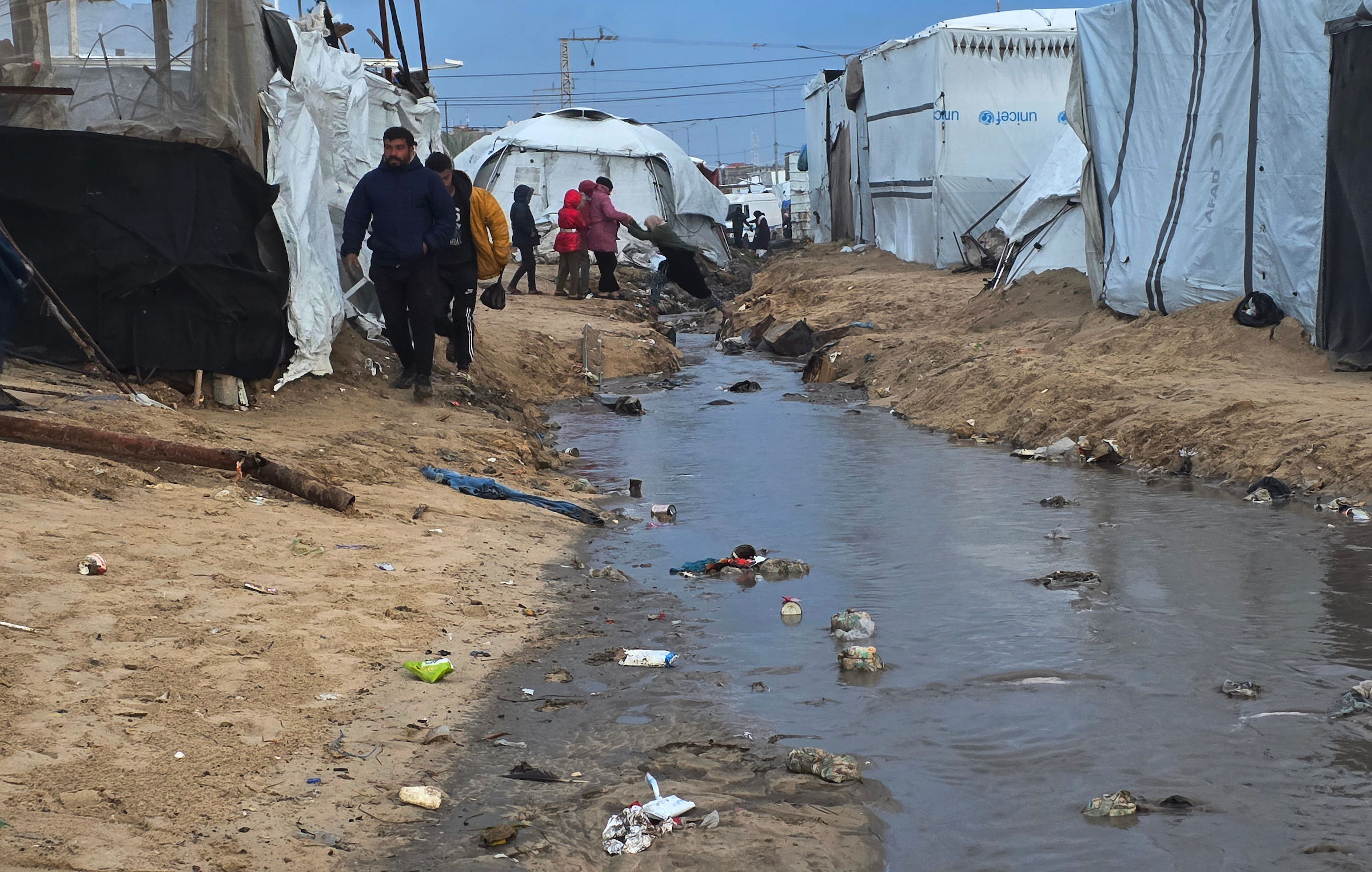
The leakage of wastewater into shelters and among displacement tents is one of the most serious crises facing the population. As wastewater networks have sustained extensive damage and large parts of the infrastructure have been destroyed, wastewater has flooded areas surrounding tents, shelters, and narrow alleys where children play, turning temporary places of refuge into hazardous environments that threaten life and public health.
Husni Muhanna,5 Spokesperson for Gaza Municipality, told PCHR’s researcher that the IOF destroyed approximately 220,000 linear meters of wastewater networks during the war and destroyed or damaged eight wastewater pumping stations across Gaza. Municipal teams were able to repair some of the damaged facilities and temporarily restore them to operation. He added that the municipality continues to face significant operational challenges, most notably the electricity crisis and the shortage of fuel required to operate pumping stations, which run continuously and require constant maintenance, as well as motor oils and batteries. According to Muhanna, the IOF continue to impose restrictions on the entry of these essential supplies into the Gaza Strip.
Displaced persons are forced on a daily basis to walk through still pools of wastewater and bad odors, while contaminants seep into areas used for sleeping, cooking, and water storage, further exacerbating their physical and psychological suffering under already harsh displacement conditions. The spread of wastewater increases the risk of infectious diseases, skin diseases, and gastrointestinal and respiratory illnesses, while also creating a conducive environment for the proliferation of disease-carrying insects and rodents. Children, older persons, pregnant women, persons with disabilities, and individuals with chronic illnesses are among the groups most vulnerable to these risks. Infections and diseases resulting from environmental contamination may lead to serious health complications that are difficult to treat amid the severe collapse of the healthcare system in the Gaza Strip.
Ahmed Al-Samari (44), a married father of four, originally from Al-Shuja’iya and currently displaced on the coast of Deir al-Balah, told PCHR’s researcher:6
“We were forcibly displaced from Gaza in September 2025 to Deir al-Balah, where we stayed in a very narrow area on the beach and set up two tents. We are suffering severely from a lack of hygiene, as I am only five meters away from the main wastewater channel in Deir al-Balah. As a result, mosquitoes and flies have spread extensively. We cannot sleep at night due to mosquito bites, and in the morning we live in constant fear, always watching our children so they do not fall into the wastewater channel. We repeatedly suffer from gastrointestinal infections and skin diseases caused by environmental contamination.”
According to observations by PCHR’s researcher, hundreds of thousands of displaced persons across the Gaza Strip have been living for months in worn-out and fragile tents that lack the bare minimum requirements for adequate housing, under extremely harsh humanitarian conditions. These tents have deteriorated severely due to prolonged use, repeated displacement following multiple evacuation orders, and adverse weather conditions. As a result, they no longer provide protection from the scorching summer heat, freezing winter cold, rain, or strong winds. Displaced persons, including women and children, older persons, and persons with disabilities, are forced to live in confined and overcrowded spaces lacking privacy and safety, which exacerbates their psychological and social suffering and negatively affects their mental and physical health. The deterioration of these tents also allows rainwater and humidity to seep into sleeping areas, damaging the few belongings remaining to them. Risks are further compounded by the spread of insects and rodents around the tents and the accumulation of waste and wastewater in their vicinity. This increases the likelihood of infectious diseases, as well as skin and respiratory illnesses. In the absence of sustainable shelter solutions and amid the continued deterioration of humanitarian conditions, these worn-out tents have become a stark symbol of the scale of the humanitarian tragedy facing the population of the Gaza Strip.
Israa’ Sha’ban (53), originally from al-Daraj neighborhood and currently displaced in a destroyed school in Al-Rimal neighborhood, western Gaza City, is married and a mother of six children. She told PCHR’s researcher:7
“After our home was destroyed, we were displaced to the southern Gaza Strip a year and a half ago. We eventually sought shelter in a tent set up at a school in western Gaza City. Because we have had to move the tent repeatedly in response to Israeli evacuation orders and relocate it to different locations, it has become torn and worn out, and I have had to sew it myself several times. Due to the holes in the tent, rats frequently enter and eat the flour and legumes we store inside. They have also damaged clothing that my daughter recently bought in preparation for her wedding next month. Life in this tent has become a living hell, yet we have no alternative shelter to turn to.”
Adham Dawoud (43), a married father of five, originally from Al-Karama neighborhood in Jabalia and currently displaced in Deir al-Balah, told PCHR’s field researcher:8
“After the ceasefire was declared in October 2025, someone donated a tent to us on the beach after telling us that he no longer needed it. My wife, children, and I have been living in it ever since. The tent was already worn out and barely suitable for habitation. I tried many times to repair it, but the winter winds repeatedly tore it apart. We have been flooded by seawater on numerous occasions due to high waves reaching our tent. Every day, we sleep next to pools of wastewater in an environment unfit for human living. We often wake up feeling exhausted and lethargic because of the bad odors and gases emanating from the wastewater and nearby waste dumps. These conditions affect our health and alertness. The children often fall asleep quickly, while I struggle to stay awake and resist these effects as much as possible.”
Rodents are currently spreading extensively among displacement tents due to the accumulation of organic waste and food scraps, coupled with the absence of regular pest control measures. This has turned shelters into a conducive environment for the proliferation of rats and mice. Meanwhile, swarms of flies, mosquitoes, and other insects are widespread, posing a threat to public health and increasing the risk of infectious, skin, respiratory, and gastrointestinal diseases, particularly among children, older persons, and those with pre-existing health conditions. The effects of this phenomenon extend beyond psychological distress and the constant fear experienced by displaced persons. Rodents and insects are vectors of numerous infectious diseases and can contaminate food supplies and already scarce water sources, further exacerbating the health risks faced by displaced persons, especially children, pregnant women, older persons, persons with disabilities, and individuals suffering from illnesses. Testimonies gathered from displaced persons indicate that rats and mice regularly enter tents, both day and night, in search of food and water. They spoil the limited household supplies available to families and cause damage to blankets, clothing, and stored food items.
Dr. Raed Abdul Karim Abu Sariya,9 a dermatologist, told PCHR’s researcher that the number of patients seeking treatment for skin conditions directly or indirectly linked to the spread of waste, rodents, insects, and contaminated water has increased significantly. These conditions include severe itching and skin rashes, as well as cases of bacterial skin infections resulting from repeated scratching of insect bites. Such conditions are particularly prevalent among children, older persons, and residents of shelters and displacement camps, where overcrowding, the accumulation of waste, and the presence of stagnant water increase exposure to insects and exacerbate associated skin problems. Abu Sariya added that blood-feeding insects are among the leading causes of skin conditions, particularly mosquitoes, bed bugs, fleas, and flies. In some overcrowded places, head lice infestations have also been observed, especially among children, causing persistent itching and potentially leading to further dermatological complications if left untreated. The prevalence of these insects varies from one area to another depending on environmental conditions, levels of hygiene, and the availability of sanitation and waste management services. He further noted that, as a result of the Israeli siege, there is a shortage of certain essential medicines and medical supplies required to treat most skin conditions, forcing healthcare providers in some cases to ration available treatments or rely on alternative therapies. Dr. Abu Sariya called on humanitarian organizations and relevant authorities to give urgent priority to public health measures and efforts to control the spread of rodents and insects, given the direct risks they pose to the health of the population, particularly amid the harsh living conditions and overcrowding in shelters. He stressed that addressing this problem requires more than medical intervention alone; it demands a comprehensive environmental response that includes improving waste management, treating wastewater, and ensuring the continuous and systematic provision of pest-control materials and supplies.
Mohammed Abu Harbeed (42), a married father of five, originally from Beit Hanoun in the northern Gaza Strip and currently displaced in Al-Rimal neighborhood in Gaza City, told PCHR’s researcher:10
“I live with my family of seven, including children, all of whom are under the age of seven, with the youngest being only two years old. We are crammed into a very small tent that is too small to accommodate all of us, where we endure hardships beyond our ability to bear. Our suffering is not limited to the cramped space, extreme heat and cold, and the lack of basic necessities. A new danger has emerged in the form of rodents and insects that have spread extensively among the tents here. As a result, my children have developed skin diseases and respiratory problems that have weakened their small bodies. Rodents also destroy the little food we are able to obtain, contaminating flour and the limited food supplies that we struggle to secure for our children. Many times, we find ourselves forced to use some of these damaged food items because we have no alternative and cannot allow our children to go to bed hungry.”
The worsening health and environmental catastrophe in the Gaza Strip has gone beyond constituting a mere humanitarian crisis and has become a direct threat to the population’s rights to life, health, survival, and human dignity. The continued and deliberate imposition of these deadly living conditions on more than two million Palestinians, coupled with prevention on the entry of relief supplies, and essential medical resources, gives rise to an urgent legal obligation on the international community to act in order to prevent further harm that may amount to acts prohibited under the Convention on the Prevention and Punishment of the Crime of Genocide.
Accordingly, PCHR: