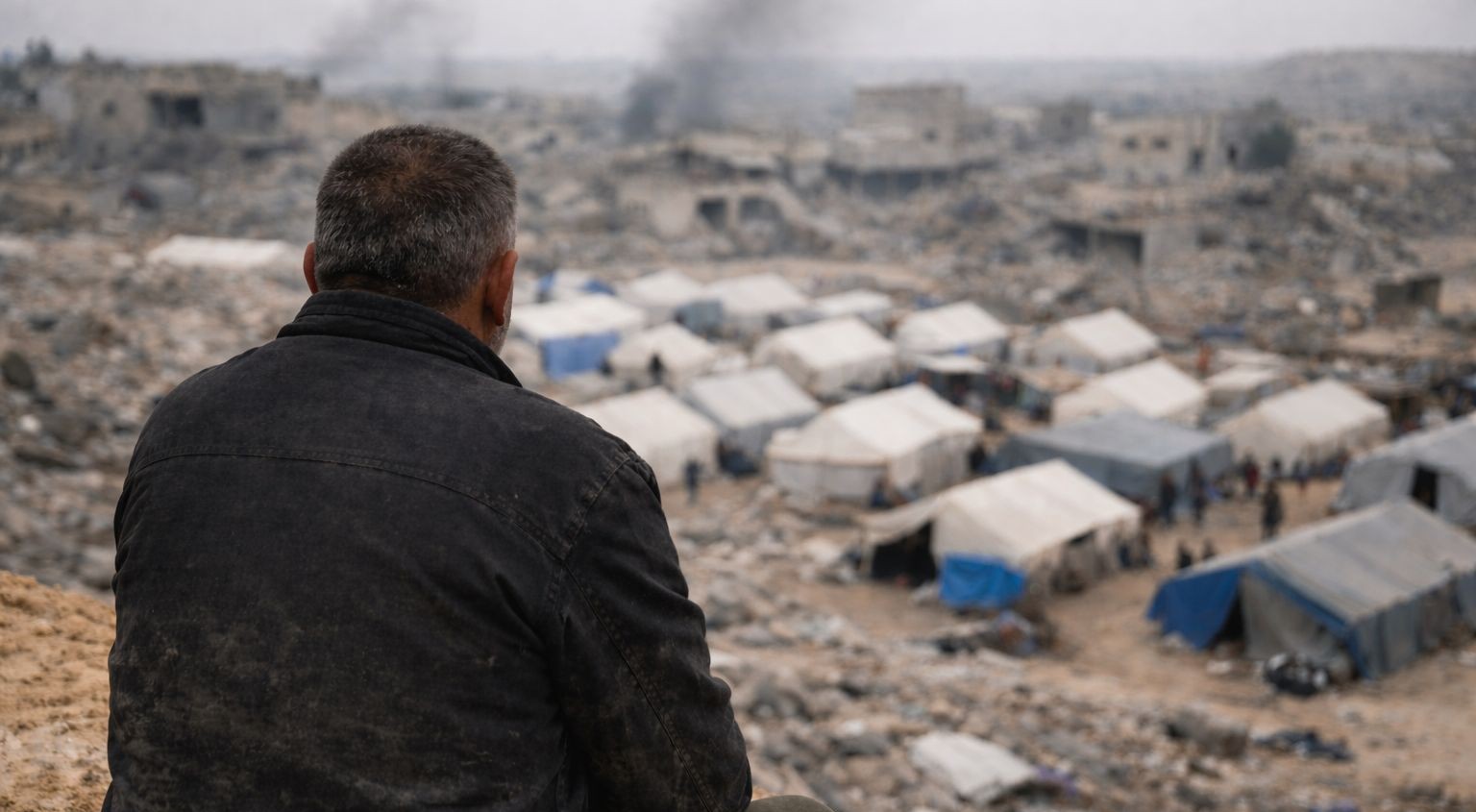
Date of Statement: 10 December 2025
Ahmed Abdel Fattah Ahmed Jabri, 48 years old, married, father of three children, resident of Khan Younis.
I lived in a ground-floor apartment in my family’s three-storey house in the Al-Amal neighbourhood of Khan Younis. When the war on Gaza began on 7 October 2023, my family, relatives, and I were at home. We remained there for months, hearing intense bombardment everywhere. With the start of the Israeli military operation in Khan Younis in early December 2023, the situation became increasingly dangerous, particularly as Israeli occupation forces and their vehicles advanced into the Al-Katiba area north of the city and approached the eastern part of Al-Amal neighbourhood, as well as its western side, including the Social Affairs area and the Taiba Towers.
Accordingly, on 7 January 2024, my wife, children, and I fled to the headquarters of the Palestinian Red Crescent Society (PRCS) in the centre of Al-Amal neighbourhood, seeking safety, as many people were doing. A few days later, my brothers and their families joined us there.
During our forced displacement, my brother Imad, 51 years old, was injured, while others were killed when an Israeli drone targeted a group of civilians on Al-Qudra Street, outside and opposite the northern side of the PRCS headquarters. I do not recall the exact date of the incident. My brother was admitted for treatment on the third floor of Al-Amal Hospital, affiliated with the PRCS, and I stayed with him as his companion.
On 5 February 2024, Israeli military vehicles advanced towards the PRCS headquarters, besieged it, and ordered the displaced persons inside to evacuate and move westward to Al-Mawasi, west of Khan Younis. People left, including my family and relatives. I remained behind with my nephew Amjad, 13 years old, to accompany his injured father, Imad.
After the evacuation, only patients, their companions, and medical staff remained—around 200 people in total. During the Israeli soldiers’ incursion into the compound, they forced us down to the ground floor, to the ophthalmology department, bound our hands behind our backs with plastic ties, and questioned us about our personal details. Israeli soldiers arrested five people—three from the medical staff and two companions—then left the PRCS compound. We remained there, and my brother Imad began to recover.
At around 2:00 a.m. on 24 March 2024, Israeli occupation forces returned and besieged the PRCS building for a second time, amid heavy gunfire and fire belts around and inside the compound. They ordered us to leave and head towards Al-Mawasi, west of Khan Younis. Chaos ensued, and we did not know what to do. While attempting to exit the building, one PRCS staff member from the Abu Eisha family was shot in the chest and fell to the ground. My brother Imad tried to help him, but as Imad raised his head, he too was shot in the face by a sniper positioned on one of the surrounding buildings. His injury was severe. I searched for a doctor but found that they had already left the compound.
My nephew Amjad, some friends, and I placed my brother on a stretcher and carried him out. As we exited the PRCS compound, tanks surrounded us on both sides of the road. We walked westward for about 500 metres until we reached the Social Affairs building, which the soldiers had turned into their base, converting the adjacent road into a checkpoint separating Al-Amal neighbourhood from the coastal area. The soldiers ordered us to place my brother on the ground and approach them. I put my brother down and walked towards a soldier visible to us from a window of the Social Affairs building. He asked for my ID card, which I did not have. He then asked for my name, which I gave. After checking my name on a phone he was holding, he ordered me to strip, gave me a white overall, and ordered me to wear it. They then bound my hands behind my back with plastic ties, blindfolded me with a cloth, and took me to the basement of the Social Affairs building. They arrested my nephew Amjad but released him after two hours. I was the first to be arrested.
In the basement, they interrogated me about whether I knew anyone from the resistance or Hamas, and about tunnels. The interrogation lasted about an hour, during which I was beaten with fists and a baton.
After the interrogation, they placed me in a room with a number of detainees. After sunset, they took me and two other detainees to a tank and loaded us inside. After about an hour of driving, the tank stopped. They unloaded us, removed our restraints, gave me underwear, a grey tracksuit, and slippers. After I put them on, they shackled my hands and feet with iron restraints and took me to a doctor, who asked whether I had chronic illnesses or had undergone previous surgeries. They then took me to another room, photographed me, took an iris scan, and placed a blue bracelet with a number I do not recall on my left wrist. They blindfolded me again and took me into a minibus, which drove for 5–10 minutes. Two soldiers led me to a room, sat me on a chair, and shackled me to it—my hands to the chair and my feet to its legs. They removed the blindfold, and I found myself in a 3×3 metre room with a desk and a computer, two soldiers behind me, and a third person who entered wearing civilian clothes—bald, fair-skinned, heavy-built, about 180 cm tall. He introduced himself as military intelligence and began interrogating me about who I knew from Islamic Jihad and Hamas, the locations of tunnels, and who had participated on 7 October.
The interrogation proceeded in rounds: he would ask questions, leave, then return. Whenever I answered “I don’t know,” I was beaten all over my body.
During the interrogation, whenever I denied knowing anyone from Islamic Jihad or Hamas or knowing about tunnels, the two soldiers behind me would beat me all over my body, focusing on punching my groin (testicles), squeezing them, and attempting to insert a pen cap into my urethra. This was repeated multiple times (I do not recall how many). Each time, I screamed in severe pain, feeling dizzy and close to losing consciousness. The last time, I could not endure it and lost consciousness. When I regained consciousness, I found myself in a hospital bed— I do not know the hospital’s name or location—shackled by my hands and feet to the bed, with a guard posted at the door. I learned that I had undergone surgery and that one of my testicles had been removed. I remained in the hospital for a week in this condition. My restraints were only removed when using the bathroom or eating. Food consisted of three meals a day, each a single chocolate-flavoured pudding cup. As for treatment, I was given one anti-inflammatory pill per day.
After a week, they returned me to the barracks of Sde Teiman detention camp, as I later learned. There, I was given antibiotics for ten days. I spent three months in Sde Teiman, during which I was subjected to repeated interrogations, beatings, and humiliation by occupation forces. I do not recall how many times. The first occurred ten days after my return from the hospital. During one interrogation, an interrogator extinguished his cigarette on the back of my neck while asking me the same questions as before. Whenever soldiers came to take me for interrogation, they would take me out of the barracks, bind my hands behind my back, blindfold me, and assault me with fists, boots, punches, and kicks while escorting me to the interrogation rooms.
I was also subjected to stress positions: my hands bound behind my back while standing; being forced to kneel; or standing with my bound hands raised above my head. If I tried to rest my hands, I would be beaten and insulted. I would remain in one of these positions for one to two hours, depending on the soldier’s mood.
I felt that the soldiers deliberately assaulted us to humiliate us, especially during transfers between barracks or to other detention areas. We were beaten with fists, kicks, batons, electrocuted, and verbally abused with obscene insults.
During transfers between barracks, soldiers would spit on their boots and order detainees to lick them. This happened to me about 20 days after I was transferred again to Sde Teiman. I refused to lick the spit, so a soldier punched me several times and shoved me into the barracks.
During detention, our day began at 5:00 a.m., when we gathered our very thin mattresses and blankets and set them aside. Roll call took place four times a day: at 5:00 a.m., noon, after sunset, and at midnight. We were forced to sit all day on our buttocks with our legs stretched forward and our hands shackled with iron cuffs. Movement and talking to neighbouring detainees were prohibited. We remained seated like this until midnight.
To use the bathroom, we had to ask permission from the guard, who would give us a number. We might wait one, two, or even three hours before being allowed to go. Showering was allowed once a week for no more than four minutes—just enough for water to touch your body before you had to get dressed, otherwise you would be beaten.
We were subjected to suppression at least twice a week. It would begin with soldiers ordering us to lie face down with our hands over our heads and throwing stun grenades. Soldiers would then enter with dogs muzzled with metal restraints; the dogs would walk over our bodies and urinate on us. Afterwards, certain detainees’ numbers would be called, they would be taken aside, beaten severely, and dogs would be released at them to terrorise them. I was severely beaten, attacked by dogs, and hung from a fence more than once. Each suppression lasted about half an hour.
After about 75 days, I was brought before a court via phone. The judge accused me of being a danger to the State of Israel and of belonging to Islamic Jihad. After three months, I was transferred to Ofer Prison. Soldiers came, took me out of the barracks, changed my hand restraints from front to back, shackled my feet, blindfolded me, and loaded me onto a bus. I was seated with my head between my knees like the other detainees; we were 30 in total. The bus journey lasted about three hours, during which we were beaten with punches and slaps and subjected to electric shocks. Soldiers ordered us to sing. The bus stopped when we reached Ofer Prison, as I later learned, and the beatings continued as we were unloaded.
After removing the blindfolds and changing restraints to the front, the soldiers told us, “Enter your new home.” I was placed in a room with 16 detainees, containing six bunk beds and a bathroom. We could use the bathroom as needed and shower once a week when water was turned on. We were subjected to suppression and torture at least twice a week, including during roll call, similar to Sde Teiman.
During my detention, I witnessed two detainees being assaulted by soldiers inserting a baton into their anus. One of them was with me in Ofer. He was called out and later returned to the room bleeding heavily from his anus and told me what had happened. Half an hour later, they took him again, and he never returned; I did not see him afterwards.
I spent nine months in Ofer Prison without interrogation. I was brought before a court via mobile phone twice, but I was not allowed to defend myself, as they prevented me from speaking, and the same charges were repeated.
After nine months, I was transferred to Negev Prison. During the transfer, as in previous times, I was beaten and verbally abused. I was placed in a cell measuring 2.5×2.5 metres with 60 detainees. They called us one by one. When my turn came, they ordered me to strip completely naked, searched me, then ordered me to dress, photographed me, and issued me an ID card. We were then transferred to the wings.
In Negev Prison, breakfast consisted of jam and yoghurt; lunch was rice with beans or lentils; dinner was rice and tuna; and throughout the day we received 11 pieces of bread. I was not interrogated there, but we were subjected to suppression when a ceasefire was announced. We cheered in joy, and soldiers stormed in and fired rubber bullets at us. I was hit by a rubber bullet in my right shoulder. I remained in Negev Prison for four and a half months.
After that, I was transferred back to Sde Teiman. Soldiers called my name, took me out of the room, bound my hands behind my back and my feet with iron shackles, and took me to a doctor. One of them then gave me new clothes to wear. They made me hold a cardboard sign with Hebrew writing I do not know, ordered me to raise it and walk a few steps, and photographed me. They then restrained me again and took me to the administration office, where they asked for my personal details, home address, and my children’s names. Afterwards, they put me in a civilian car that drove to Sde Teiman. There, I was examined by a doctor, given a blue plastic bracelet with the number 077429, had my foot shackles removed, and was placed in a room with three detainees. My hands remained shackled for three days.
At around 10:00 p.m. on my first day back in Sde Teiman, soldiers came, called my name, threw a stun grenade near me inside the room, ordered me to step back with my hands over my head, then dragged me out, changed my hand restraints to the back, shackled my feet, and placed me in a cell measuring 1.5×1.5 metres with a toilet.
At around 9:00 a.m. the next day, they took me to an interrogation room with an officer who introduced himself as intelligence. He asked for my personal details and ordered me not to cause problems and to sit respectfully. The meeting lasted about ten minutes, after which I was returned to the cell.
At around 2:00 p.m., they returned me to the room where movement and walking were prohibited. We were awakened at 5:00 a.m. and remained seated until midnight. Roll call was conducted four times daily, and food consisted of three meals as before, in insufficient quantities. I spent, to the best of my recollection, about 70 days or more in Sde Teiman.
We were subjected to daily suppression, morning or evening. It would begin with stun grenades, and we were ordered into the corridor to kneel with our hands raised. If I tried to lower my hands due to exhaustion, I would be beaten with punches and kicks for hours. As punishment, I was sometimes restrained with my hands and feet bound behind my back for three consecutive days inside the room, during which fellow detainees helped me eat, drink, and use the bathroom.
After roll call, at around 6:00 a.m. on Sunday, 7 December 2025, soldiers came, took us out of the room, removed our restraints, ordered us to strip naked, searched us, then ordered us to dress, restrained us again, and returned us to the room. They came back around 8:00 a.m. and called my name and another detainee’s. A soldier asked me if I needed anything; I said no. They left, then returned three hours later with tuna food for me and the other detainee. After eating, they placed us in a cage with our hands restrained in front and blindfolded. After an hour and a half, three more detainees were brought, making five of us. They took us out of the cage, shackled our feet, and loaded us onto a bus that drove for an hour and a half to an unknown destination. The bus stopped, and after half an hour, a soldier informed us that we would be released and that our restraints would be removed one by one. Whoever was freed was to run quickly towards the gate.
When my restraints were removed, a soldier gave me water and a biscuit and told me to run towards the gate of Kerem Shalom Crossing. I ran, along with the other detainees, and found the International Committee of the Red Cross waiting for us. They transported us by bus to Al-Aqsa Martyrs Hospital in Deir al-Balah.
On the way, I used a Red Cross staff member’s phone to call my friend Khader Abu Muslim, 47 years old, who had been detained with me and released five days earlier, to inform my family to come to the hospital. Upon arrival, doctors examined me. I did not tell them about the removal of my testicle and did not obtain any medical report. I found my family at the hospital and left with them to return home.
As for my brother Imad, during my detention in Negev Prison, after some detainees were transferred to us, one of them told me that he had been detained with my nephew Nidal Imad Jabri, 21 years old, who informed him that my brother Imad had died of his wounds seven to ten days after my arrest.

I was recently scammed out of $53,000 by a fraudulent Bitcoin investment scheme, which added significant stress to my already difficult health issues, as I was also facing cancer surgery expenses. Desperate to recover my funds, I spent hours researching and consulting other victims, which led me to discover the excellent reputation of Capital Crypto Recover, I came across a Google post It was only after spending many hours researching and asking other victims for advice that I discovered Capital Crypto Recovery’s stellar reputation. I decided to contact them because of their successful recovery record and encouraging client testimonials. I had no idea that this would be the pivotal moment in my fight against cryptocurrency theft. Thanks to their expert team, I was able to recover my lost cryptocurrency back. The process was intricate, but Capital Crypto Recovery’s commitment to utilizing the latest technology ensured a successful outcome. I highly recommend their services to anyone who has fallen victim to cryptocurrency fraud. For assistance contact Recoverycapital @ fastservice. com and on Telegram OR Call Number +1 (336)390-6684 via email: Capitalcryptorecover@zohomail. com you can visit his website: https://recovercapital.wixsite.com/capital-crypto-rec-1
Hello I`m very happy today with my family. My name is Violet Barnes, and I live in the United Kingdom. My husband left me for a good 3 years now, and I love him so much, I have been looking for a way to get him back since then. I have tried many options but he did not come back, until I met a friend that darted me to Dr Peter, a spell caster, who helped me to bring back my husband after 24 hours. My husband and I are living happily together today, That man is great, Now I will advise any serious persons that found themselves in this kind of problem to contact him now for a fast solution without stress.. contact him now on his email (drpeterspellcaster21@gmail.com) or WhatsApp: +2348162247974
drpeterspellcaster.wixsite.com/my-site-1
64a92941614d1.site123.me
https://drpeterspellcaster.godaddysites.com/
Hello my name is Sally my fiancé broke up with me last week i was so sad I changed completely, I wasn’t eating and i wasn’t talking to anybody, I cried a lot, I was so depressed and stressed out that I was scared I’m going to end up in the hospital because of all the stress and depression until one day i search online on getting love tips because I Love & care about him deeply and I just want us to be together as a couple again and I want us to last forever then i found a powerful spell caster Called Priest Ade that he solved so many relationship problem then Priest Ade told me he will come back to me between 24hrs after he cast spell on him never believe it until my fiancé called me on the phone and told me he want us to come back and live happily together forever , Am so happy now that Priest Ade help me bring my finance back to me. Thanks so much Priest Ade he can also help you Email him at ancientspiritspellcast@gmail.com
Website ancientspellcast.wordpress.com WhatsApp: +2347070518515
Late last year, I unintentionally fell for a cryptocurrency fraud. A Facebook imposter persuaded me through a phishing scam about how I could make a sizable profit from a legitimate cryptocurrency company, which he claimed assisted traders in investing and making big profits. They took advantage of me and made off with $114000 worth of cryptocurrency.As this was money I had worked so hard to obtain, I was shocked and uncomfortable. After reading favorable reviews and internet testimonials about a recognized team led by jbeespyhack, I learned how adept they are at any type of hacking and cryptocurrency recovery. They were able to get my money back once we had a talk. This was the best I could do to express my gratitude to them. jbeespyhack can be reached.
Contact;jbeespyhack@gmail.com
Wow what a good God I am so excited to tell you all how I become a millionaire I’m a woman of faith I was reading a comment on google where I meet a man sharing how Dr UYI cast a spell for him and he get his wife back after the spell I was interested I have to do research when I was doing the research I got so many testimony about this same man call Dr UYI how he help people to win lottery how he help people to get there ex back how he help people to do so many things I was happy and I contact him to help me win the lottery when I contact him and he told me what to do and after I did what he ask me to do he den gave me a lottery number to play and told me to go and buy ticket after playing the game I was so surprise the game come out good and I won the sum of 90, 000,000 dollars i was amazed and promise to share it to the people around me if anyone is willing to play the mage lottery it should contact Dr UYI so he can give you the right number to play thanks to you Dr UYI I’m so so grateful contact Dr UYI via drzukalottospelltemple@gmail.com OR WhatsApp on +17174154115
I was recently scammed out of $53,000 by a fraudulent Bitcoin investment scheme, which added significant stress to my already difficult health issues, as I was also facing cancer surgery expenses. Desperate to recover my funds, I spent hours researching and consulting other victims, which led me to discover the excellent reputation of Capital Crypto Recover, I came across a Google post It was only after spending many hours researching and asking other victims for advice that I discovered Capital Crypto Recovery’s stellar reputation. I decided to contact them because of their successful recovery record and encouraging client testimonials. I had no idea that this would be the pivotal moment in my fight against cryptocurrency theft. Thanks to their expert team, I was able to recover my lost cryptocurrency back. The process was intricate, but Capital Crypto Recovery’s commitment to utilizing the latest technology ensured a successful outcome. I highly recommend their services to anyone who has fallen victim to cryptocurrency fraud. For assistance contact Recoverycapital @ fastservice. com and on Telegram OR Call Number +1 (336)390-6684 via email: Capitalcryptorecover@ zohomail. com
I’m sorry the world has allowed this to happen to you, Ahmed.
We have failed you.
You deserve so much better, dear brother.
🇵🇸
Got scammed of $447k on a bitcoin investment platform. i agree iwas stupidd. It turned out the platform operated as a Ponzi scheme. I reported to the authorities and was made to write a series of statements which they didn’t follow through nor amount to anything, hence delaying the investigation. I lost my mind completely until a friend recommended me to cybersafe_001@yahoo.com a smart contract funds recovery expert who interceded and helped me recover most of what was swindled, thank you sir
“In the crypto world, this is great news I want to share. Last year, I fell victim to a scam disguised as a safe investment option. I have invested in crypto trading platforms for about 10yrs thinking I was ensuring myself a retirement income, only to find that all my assets were either frozen, I believed my assets were secure — until I discovered that my BTC funds had been frozen and withdrawals were impossible. It was a devastating moment when I realized I had been scammed, and I thought my Bitcoin was gone forever, Everything changed when a close friend recommended the Capital Crypto Recover Service. Their professionalism, expertise, and dedication enabled me to recover my lost Bitcoin funds back — more than €560.000 DEM to my BTC wallet. What once felt impossible became a reality thanks to their support. If you have lost Bitcoin through scams, hacking, failed withdrawals, or similar challenges, don’t lose hope. I strongly recommend Capital Crypto Recover Service to anyone seeking a reliable and effective solution for recovering any wallet assets. They have a proven track record of successful reputation in recovering lost password assets for their clients and can help you navigate the process of recovering your funds. Don’t let scammers get away with your hard-earned money – contact Email: Recoverycapital @ fastservice. com
Phone CALL/Text Number: +1 (336) 390-6684 Contact: Capitalcryptorecover @ zohomail. com
Website: https://recovercapital.wixsite.com/capital-crypto-rec-1
I have been suffering from Herpes for the past 1 years and 8 months, and ever since then I have been taking series of treatment but there was no improvement until I came across testimonies of Dr. Silver on how he has been curing different people from different diseases all over the world, then I contacted him as well. After our conversation he sent me the medicine which I took according to his instructions. When I was done taking the herbal medicine I went for a medical checkup and to my greatest surprise I was cured from Herpes. My heart is so filled with joy. If you are suffering from Herpes or any other disease you can contact Dr. Silver today on this Email address: drsilverhealingtemple@gmail.com
“In the crypto world, this is great news I want to share. Last year, I fell victim to a scam disguised as a safe investment option. I have invested in crypto trading platforms for about 10yrs thinking I was ensuring myself a retirement income, only to find that all my assets were either frozen, I believed my assets were secure — until I discovered that my BTC funds had been frozen and withdrawals were impossible. It was a devastating moment when I realized I had been scammed, and I thought my Bitcoin was gone forever, Everything changed when a close friend recommended the Capital Crypto Recover Service. Their professionalism, expertise, and dedication enabled me to recover my lost Bitcoin funds back — more than €560.000 DEM to my BTC wallet. What once felt impossible became a reality thanks to their support. If you have lost Bitcoin through scams, hacking, failed withdrawals, or similar challenges, don’t lose hope. I strongly recommend Capital Crypto Recover Service to anyone seeking a reliable and effective solution for recovering any wallet assets. They have a proven track record of successful reputation in recovering lost password assets for their clients and can help you navigate the process of recovering your funds. Don’t let scammers get away with your hard-earned money – contact Email: Recoverycapital @ fastservice. com
Phone CALL/Text Number: +1 (336) 390-6684 Contact: Capitalcryptorecover @ zohomail. com
The United Nations spends $158 billion dollars a year towards research in finding a cure for infection & diseases like tremor, anxiety & depression, psoriasis, shingles, eczema, urethra wart, chronic problems. Herpes, Cancer, ALS, Hepatitis, Diabetes, HPV, Psoriasis, ulcer, respiratory obstruction. They don’t want a cure because there’s no profit in it for them and the pharmaceutical industry let truth be told please, that’s more reason why I venture into herbal treatment, and I was able to cure myself from diseases that they said were incurable medically .Sometimes you don’t always have to give up on everything you do and let someone else decide your fate .Doctor Ede herbs are very essential and it has the potential to cure the so-called incurable. His contacts are always active. Check out his email to order your medicine via medicalmediumherbal@gmail.com or WhatsApp: +2347035623817
FRESH FULLZ UPDATED-2026 AVAILABLE
USA UK CANADA GERMANY SPAIN ITALY AUSTRALIA
Tax Return 2026 Filling Fullz
Children Fullz 2011-2023
Young & Old Age Fullz 1930-2009
High Credit Score 700+ Scores
DL & ID Photos Front Back with selfie
DL Photos available all countries
Passport Photos
W-2 Forms with DL Photo (2021-22-23)
USA LLC Docs with DL & SSN
USA-> Name SSN DOB DL Address City State Zip Phone Email Employee & Bank Info
UK-> Name NIN DOB DL Address City State Postcode MMN Account number Sort Code
Canada-> Name SIN DOB DL Address City State Zip Phone MMN
Many Other Countries Fresh Fullz available in Bulk quantity
All Info will be provided with guarantee
Tax Filling Tools & Tutorials available
Our Team Is working 24/7 & here we’re:
————————————–
Telegram@killhacks – @ leadsupplier
What’s App – (+1) 727”’788”’6129
Telegram Channel – t.me/leadsproviderworldwide
Discord – @ leads.seller
VK Messenger – @ leadsupplier
Signal – @ killhacks.90
Email – hacksp007 at gmail dot com
Zangi – 17-7369-4210
Email Leads & phone number Leads
Crypto, Forex, Investors Leads
Payday & Loan Leads
Doctors Database, Health & Medical Leads
Car Database with Reg Numbers
Email & Pass Combos
Office365 Leads & Logins
Crypto Exchanges Leads
LinkedIn, Facebook, Instagram Leads
Education & School Leads
TOOLS & TUTORIALS AVAILABLE
H@cking Sp@mming C@rding Sc@M Pages Scripting Tools
Complete packages for Sp@mming & Ph!shing Attack
Sqli Injectors & Pen3tratrion Tools with tutorials
SMTP Linux Root & Sc@m Page Scripting
C@rding Tools & Tutorials (For CC|CVV Cash out & Dumps)
We are also providing complete packages for the above listed stuff
Complete guidance & assistance will be provided
Just try our services, we’ll give your best
#fullz #usafullz #canadafullz #ukfullz #taxreturn2026 #usataxreturn #dlphotos
#personalID #leads #taxfillingfullz #usataxfilling #childrenfullz #trumpiran #indiarussia
#chinausa #usachina #MAGA #Btc #btcbullrun #cryptocrash #cryptobill #eth #altseason
*Be aware from the scammers using our cloned names
I used to be a very poor woman who has always not found luck when it comes to playing the lottery. I have been playing the lottery since i was 21 years and now i am 45 meaning i have been playing lottery for 24 years. The biggest amount I have ever won in my life was 400 bucks. But one day my story turns to history after I find this man’s name on the Internet that he is the best when it comes to winning the lottery. This man is a very strong voodoo doc who gives out the numbers that can never fail. After all my years of laboring and struggling to win the lottery i finally won ( $27,000,000) Dr Alli is the name, Email: allispellhelp1@gmail.com or contact him on his whatsApp number +18033346682 this is the only way to win the lottery and the best way
I NEED A HELP HOW TO RECOVER MY LOST CRYPTOCURRENCY
I know many things could have gone wrong these past few days investing online and getting burnt. I was also in your shoes when I invested in a binary option where I got scammed of $3000 of BTC but thanks to the help of TSUTOMU SHIMOMURA They assisted me in recovering back my lost BTC. I initially didn’t trust them but I was referred to by a friend who I trust well. I was able to get my refund within the space of 24HRS . Thanks to TSUTOMU SHIMOMURA, you can also contact them Email addresstsutomushimomurahacker@gmail.com, and I’m sure you will be happy you did.
I NEED A HELP HOW TO RECOVER MY LOST CRYPTOCURRENCY
I know many things could have gone wrong these past few days investing online and getting burnt. I was also in your shoes when I invested in a binary option where I got scammed of $3000 of BTC but thanks to the help of TSUTOMU SHIMOMURA They assisted me in recovering back my lost BTC. I initially didn’t trust them but I was referred to by a friend who I trust well. I was able to get my refund within the space of 24HRS . Thanks to TSUTOMU SHIMOMURA, you can also contact them Email addresstsutomushimomurahacker @ gmail.com, and I’m sure you will be happy you did.
Get professional help to put you through if you want to get back your money from any fake investment, crypto trade, ponzi scheme, Fake jobs, wallet hacks or whatever the issue is. SolidBlockForensics are reputable. Their profound expertise is top notch and straight to action.
They’re the Best out there. Get Help now to recover your funds.
http://www.solidblockforensics.com
Cryptocurrency Romance Scam Assistance – Fast Swift Cyber Services
Fast Swift Cyber Services specializes in providing guidance and investigative support to individuals affected by romance-related cryptocurrency fraud. After I personally experienced a fraudulent crypto investment scheme and spent months trying to understand what happened, I contacted Fast Swift Cyber Services for help.
Throughout the process, they maintained clear and consistent communication, kept me informed of developments, and answered my questions with patience and transparency. They also offered practical advice on recognizing and avoiding similar scams in the future.
What stood out most was their ethical and realistic approach. They made no exaggerated promises or guarantees, but instead focused on careful analysis and legitimate recovery pathways. Over time, their efforts led to measurable progress in addressing my case and recovering a portion of the funds.
For anyone seeking informed support after a cryptocurrency romance scam, Fast Swift Cyber Services provides a professional and responsible approach.
WhatsApp : +1 812,,380..0994
fastswift @ cyberservices . com
Website : https://fastswiftcyberservices.com
CERTIFIED ETHEREUM / USDT & BITCOIN RECOVERY EXPERT / HIRE GEO COORDINATES RECOVERY HACKER
After losing $780,000 worth of bitcoin . I thought I’d never recover my money back. I’ve been in this predicament, and I can attest to the frustration and helplessness that come with it until I met a testimony of Alexa Jason online talking about GEO COORDINATES RECOVERY HACKER who helped him recover his funds back. I decided to give it a try and contacted them on
Email: geovcoordinateshacker@gmail.com
Website; https://geovcoordinateshac.wixsite.com/geo-coordinates-hack
Telegram @Geocoordinateshacker
Luckily for me as I speak to you all, my funds have been recovered and were delivered to me within 24 hours. I can’t thank GEO COORDINATES RECOVERY HACKER enough for the incredible help they provided during one of the toughest times in my life. I will forever be grateful to them for giving me back not only my money but also my peace of mind.
HOW I WON THE LOTTERY WITH Drherry LOTTERY SPELL AND MY LIFE CHANGED: I’m a 31-year-old from California and I just won $25 million in the lottery. Life was really hard before this and I was constantly struggling to pay my bills. While searching online for ways to turn things around, I came across stories of people saying that Drherry helped them win the lottery. I was curious and decided to give it a try. I reached out to him and he responded quickly. He told me what was needed to cast a lottery spell. After the spell was done, he gave me numbers to play. I used OLG’s Never Miss a Draw subscription and a few days later, I got a call saying I had won $25 million. I was completely shocked and overwhelmed with emotion. I never believed something like this could happen to me. I am truly grateful to Drherry for this incredible blessing. You can contact him via WhatsApp: +12023654871 or email: DrHerry189@gmail.com
My Companies Crypto Investment Money was Hacked So we had to find the Best and Most Legitimate Crypto Recovery Agency, That was when we came across Treqora .com we had seen lots of reviews about them but the one that caught our attention was Danica Patrick’s good words about them , for those of you who don’t know Danica Patrick she was a former F1 Racer with some nice records , So seeing her video review and testimony about Treqora we needed to reach out to them to help recover our Crypto Investment. Thank Goodness they were able to deliver in less than 4weeks we got everything we lost back with no Upfront Payment. Grateful to Treqora for a job well done.Reach out to the Best Crypto Recovery Agency Treqora, if you want to get back your cryptocurrency from hackers , ponzi schemes, Investment platforms. Recover lost Bitcoins with Treqora.
I lost my marriage after 2 years and it was a horrible experience for me. My wife left me and my son and everything happened beyond my control and I never knew few people around me engineered my wife and turned her against me just because I choose to build my family and focus more on it. I had to seek help because I know I did not do anything to have my marriage crashed. Dr OGBO helped me and a lot was revealed to me on what transpired. He cast a love reunion spell that bonded my wife and I back together and the whole evil my family did against me was revealed. Am thankful that my home is back more happier than ever and all the appreciation goes to Dr OGBO as he indeed fixed my problems just after 48 hours. Review /contact him on his page: psychicogboreading@gmail.com or text him on WhatsApp +2349057657558.,,
With my experience working with Dr Isikolo, i came to the conclusion there are very good and honest people out there who can truly do all they can to fix whatever problems you have even when they are not known to you visibly or see them in person. I lost my marriage for not being able to fully what it means to lead a woman right and accept the fact that they are wired in a way we men can never understand. I had to seek help from Dr Isikolo knowing my wife is a good woman whom i cant loose to anyone else. It was a tough situation for me though and too many things was revealed to me while he was helping me to fix the problems and i got the effect of the result just after 48 hours as he assured me and i have my wife back home to me. Dr Isikolo is the best option you can choose to restore love and connection between you and your partner and get back them back to your lives and be happy together forever. You can call/text him via WhatsApp +234-8133261196 or click on his webpage and see more details about his good works. https://isikolo-temple.com
TSUTOMU SHIMOMURA IS BEST HACKER
WARNING: Scammers will stop at nothing to steal your hard-earned money! But, I’m living proof that TSUTOMU SHIMOMURA can help you RECLAIM YOUR LOST FUNDS! I thought I’d lost my life savings of $58,000 after investing with a fake broker, promising me a whopping $187,000 profit to fund my urgent surgery. But, TSUTOMU SHIMOMURA did not give up on me. They worked tirelessly to track down my money and recover it. And, after months of intense effort, they successfully recovered my entire investment – $58,000! I’m now able to focus on my health and recovery, knowing that I’ve been given a second chance thanks to TSUTOMU SHIMOMURA Don’t let scammers ruin your life like they almost did mine! If you’re in a similar situation, don’t hesitate to reach out to TSUTOMU SHIMOMURA. They’ll be your champion in the fight against online fraud!” be happy you did. You can also contact them by Email address tsutomushimomurahacker@gmail.com, or WhatsApp +1 (806) 283-5031 Telegram +1 (803) 632-0791
Hello my name is Sally my fiancé broke up with me last week i was so sad I changed completely, I wasn’t eating and i wasn’t talking to anybody, I cried a lot, I was so depressed and stressed out that I was scared I’m going to end up in the hospital because of all the stress and depression until one day i search online on getting love tips because I Love & care about him deeply and I just want us to be together as a couple again and I want us to last forever then i found a powerful spell caster Called Priest Ade that he solved so many relationship problem then Priest Ade told me he will come back to me between 24hrs after he cast spell on him never believe it until my fiancé called me on the phone and told me he want us to come back and live happily together forever , Am so happy now that Priest Ade help me bring my finance back to me. Thanks so much Priest Ade he can also help you Email him at ancientspiritspellcast@gmail.com
Website ancientspellcast.wordpress.com WhatsApp: +2347070518515
Raised two kids alone, worked overtime as a cashier, bought school supplies myself, saved $310K for their college and a better home. ‘Emily’ connected online, shared my struggles, pitched “ethical” charity-linked investments with 20% monthly returns to help families. Trusted her story, sent it all. Lost everything. Locked in bathroom, collapsed crying—sure I’d stolen my kids’ future. Found JetWebHackers at midnight. Messaged broken. They traced fast, recovered full $310K in weeks. Funds arrived… held kids’ photo, tears of joy overflowing. They rebuilt my hope. If scammed, don’t give up—JetWebHackers are real saviors. Thank you deeply! God bless.
#JetWebHackers
EEMAIL: support@jetwebhackers.com
WhatsApp: +1 (260) 228-9998
My husband whom I built my life with for 23 years left me and the kids without a word. Everything came crashing down on me and I reached out to our loved ones and no one could help. There came a time he filed for divorce even when we had no issues or ever fought over anything disastrous. Dr Isikolo came to my rescue and fixed the problem I had with my man. He reunited us back together again and he returned home to us. Indeed life is mysterious and I never thought I would experience what I did went through but all thanks to Dr Isikolo who worked for me and assured me of the positive results after 48 hours which indeed came to pass as he promised. He can as well fix your problems if you contact him now. Text him on WhatsApp him on +2348133261196 or review his page: https://isikolo-temple.com
Dr. Ogbo spell cast a lasting impact, and I’m forever grateful for his help in saving my marriage. His compassion, understanding, and professionalism made the entire process smooth and effective. I’m living proof that Dr. Ogbo spells work. If you’re facing marital problems or struggling to reconnect with your partner, I highly recommend seeking his help. He genuinely cares about his clients and will stop at nothing to ensure their happiness. Thank you, Dr. Ogbo, for changing my life and bringing my husband back to me.
Email:psychicogboreading@gmail.com
Call/Whatsapp +2349057657558
I was recently scammed out of $53,000 by a fraudulent Bitcoin investment scheme, which added significant stress to my already difficult health issues, as I was also facing cancer surgery expenses. Desperate to recover my funds, I spent hours researching and consulting other victims, which led me to discover the excellent reputation of Capital Crypto Recover, I came across a Google post It was only after spending many hours researching and asking other victims for advice that I discovered Capital Crypto Recovery’s stellar reputation. I decided to contact them because of their successful recovery record and encouraging client testimonials. I had no idea that this would be the pivotal moment in my fight against cryptocurrency theft. Thanks to their expert team, I was able to recover my lost cryptocurrency back. The process was intricate, but Capital Crypto Recovery’s commitment to utilizing the latest technology ensured a successful outcome. I highly recommend their services to anyone who has fallen victim to cryptocurrency fraud. For assistance contact Recoverycapital @ fastservice. com and on Telegram OR Call Number +1 (336)390-6684 via email: Capitalcryptorecover@ zohomail. com you can visit his website: https://recovercapital.wixsite.com/capital-crypto-rec-1
FOR CRYPTOCURRENCY RECOVERY, CONTACT TSUTOMU SHIMOMURA
This is the best crypto recovery company I’ve come across, and I’m here to tell you about it. TSUTOMU SHIMOMURA was able to 5:15 PM 30/11/2025 RIGHT GHH recover my crypto cash from my crypto investment platform’s locked account. TSUTOMU SHIMOMURA just needed 24HRS to restore the $620,000 I had lost in cryptocurrencies. I sincerely appreciate their assistance and competent service. TSUTOMU SHIMOMURA may be relied on since they are dependable and trustworthy. You can also contact them via Email: tsutomushimomurahacker@gmail.com Or WhatsApp +1 (806) 283-5031 Telegram +1 (803) 632-0791 and I’m sure you will be happy you did.
FOR CRYPTOCURRENCY RECOVERY, CONTACT TSUTOMU SHIMOMURA
This is the best crypto recovery company I’ve come across, and I’m here to tell you about it. TSUTOMU SHIMOMURA was able to 5:15 PM 30/11/2025 RIGHT GHH recover my crypto cash from my crypto investment platform’s locked account. TSUTOMU SHIMOMURA just needed 24HRS to restore the $620,000 I had lost in cryptocurrencies. I sincerely appreciate their assistance and competent service. TSUTOMU SHIMOMURA may be relied on since they are dependable and trustworthy. You can also contact them via Email: tsutomushimomurahacker @ gmail.com Or WhatsApp +1 (806) 283-5031 Telegram +1 (803) 632-0791
“In the crypto world, this is great news I want to share. Last year, I fell victim to a scam disguised as a safe investment option. I have invested in crypto trading platforms for about 10yrs thinking I was ensuring myself a retirement income, only to find that all my assets were either frozen, I believed my assets were secure — until I discovered that my BTC funds had been frozen and withdrawals were impossible. It was a devastating moment when I realized I had been scammed, and I thought my Bitcoin was gone forever, Everything changed when a close friend recommended the Capital Crypto Recover Service. Their professionalism, expertise, and dedication enabled me to recover my lost Bitcoin funds back — more than €560.000 DEM to my BTC wallet. What once felt impossible became a reality thanks to their support. If you have lost Bitcoin through scams, hacking, failed withdrawals, or similar challenges, don’t lose hope. I strongly recommend Capital Crypto Recover Service to anyone seeking a reliable and effective solution for recovering any wallet assets. They have a proven track record of successful reputation in recovering lost password assets for their clients and can help you navigate the process of recovering your funds. Don’t let scammers get away with your hard-earned money – contact Email: Recoverycapital @ fastservice. com
Phone CALL/Text Number: +1 (336) 390-6684 Contact: Capitalcryptorecover @ zohomail. com
Website: https://recovercapital.wixsite.com/capital-crypto-rec-1
YOU CAN RECOVER YOUR STOLEN FUNDS WITH THE HELP OF // THE HACK ANGELS RECOVERY EXPERT
The most reputable and trustworthy recovery experts available today. THE HACK ANGELS RECOVERY EXPERT. They can help you retrieve your stolen crypto funds. They have technical expertise resources to track down and recover lost crypto. I had lost £973,000 to fraud and at first I thought it was gone for good. I went online to search for recovery, I saw numerous testimonies regarding THE HACK ANGELS RECOVERY EXPERT and how they had assisted other people in getting their money back. I didn’t hesitate to contact them, in just a few days the experts returned all my money. They said that they did an investigation and returned my money immediately. They can never ask you for any upfront payment. They can help you track your funds. They are cyber security experts doing great jobs out there. Be wise and do your research to avoid being scammed again. For anyone in a similar situation seeking to recover funds lost to online scams, contact THE HACK ANGELS RECOVERY EXPERT through
WhatsApp +1(520)200-2320
EMAIL: support@thehackangels.com
Website; at (www.thehackangels.com
I just have to introduce this hacker that I have been working with him on getting my credit score been boosted across the Equifax, TransUnion and Experian report. He made a lot of good changes on my credit report by erasing all the past eviction, bad collections and DUI off my credit report history and also increased my FICO score above 876 across my three credit bureaus report he also helped me with my recover my cryptocurrency that i invested in a scam cryptocurrency company you can contact him for all kind of hacks . Email him here via EMAIL ETHICALHACKERS009 @ gmail com or whatsapp +1 4 1 0 6 3 5 0 6 9 7
I lost my marriage after 2 years and it was a horrible experience for me. My wife left me and my son and everything happened beyond my control and I never knew few people around me engineered my wife and turned her against me just because I choose to build my family and focus more on it. I had to seek help because I know I did not do anything to have my marriage crashed. Dr Isikolo helped me and a lot was revealed to me on what transpired. He cast a love reunion spell that bonded my wife and I back together and the whole evil my family did against me was revealed. Am thankful that my home is back more happier than ever and all the appreciation goes to Dr Isikolo as he indeed fixed my problems just after 48 hours. website: https://isikolo-temple.com or text him on WhatsApp via +2348133261196
After I and my husband got married, we relocated to another city and we both got jobs and started working and living together happily. We never had any problems until a colleague of his started doing all she can to get my husband’s attention. I never knew all along what was going until he started sleeping out and making excuses. Things got out of control and he eventually stopped attending to my needs. I knew at that point I needed help so I contacted Dr Isikolo and explained everything to him. He told me all that has been going and promised to fix the problems for me which he did. He cast a love reunion spell for me which reunited i and my husband and he started being the man I always loved him to be just after 48 hours Dr Isikolo worked for me. We are both happy now and it would not have been possible if not for Dr Isikolo. Contact him if you need any help. His email: page: https://isikolo-temple.com or text him on WhatsApp +2348133261196.
BEST AGENCY TO RECOVER LOST OR STOLEN CRYPTOCURRENCY
I recommend Hack Recovery TSUTOMU SHIMOMURA to anyone who needs this service. I decided to get into crypto investing and I lost my crypto to an investor late last year. The guy who was supposed to manage my account was a fraud the whole time. I invested $180,000 and at first my read and profit margins looked good. I got worried when I couldn’t make withdrawals and realized I had been tricked. I found some testimonials that people had to say about Hack Recovery TSUTOMU SHIMOMURA and how helpful it was in getting their money back. I immediately contacted him via. Email: tsutomushimomurahacker@gmail.com, Or WhatsApp +1 (806) 283-5031 Telegram +1 (803) 632-0791 and I’m sure you will be happy you did.
It gladdens my heart to be out here to say a word of thank you to Dr Isikolo.
I never thought I would be able to see my marriage work again despite the fact that everything had already been working against me, Dr Isikolo came to my rescue. I had a problem in my home which made my husband left and I was already pregnant and it became difficult for me to cope without him in my life. His family supported me all along but no one could help reunite us back except Dr Isikolo who responded at the time I needed help the most. He got the problem fixed and my husband returned back home to me just after 48 hours because he was still living in the same city with me. It quite amazing when you find help where you least thought you can get help. Once again thank you Dr Isikolo for all you do to help people in dire need of assistance. Review/contact him via his page: https://isikolo-temple.com or Call o text him on WhatsApp +2348133261196
THE MOST CREDIBLE CRYPTO RECOVERY: TOP RECOVERY EXPERT
TOP RECOVERY EXPERT is a reliable and legitimate company that can help recover lost cryptocurrency assets. After weeks of wondering if my lost BTC could ever be restored, I realized how frequent cryptocurrency scams have become. When dealing with individuals online, especially regarding money, caution is essential. Recovering stolen cryptocurrency is possible, but it’s important not to fall victim to another scam—there are many fake “recovery companies” worldwide. Real hackers work discreetly and do not advertise themselves in such obvious ways. I personally experienced multiple scams while desperately seeking help to recover my lost funds. Finally, a friend introduced me to TOP RECOVERY EXPERT, a trustworthy and discreet team. They handle everything from securing personal or company websites to recovering cryptocurrency assets. With their help, I successfully recovered $680,000 worth of USDT in just over a week. Their professionalism, discretion, and prompt service were outstanding. If you’ve been compromised, don’t lose hope—and be careful of fraudsters posing as saviors. TOP RECOVERY EXPERT are real professionals in crypto recovery. I am living proof of their effectiveness. you can reach them by email: Toprecoveryexpert AT consultant. com OR you contact their Phone Call/Text: +1 (346) 980-9102
THE MOST CREDIBLE CRYPTO RECOVERY: TOP RECOVERY EXPERT
TOP RECOVERY EXPERT is a reliable and legitimate company that can help recover lost cryptocurrency assets. After weeks of wondering if my lost BTC could ever be restored, I realized how frequent cryptocurrency scams have become. When dealing with individuals online, especially regarding money, caution is essential. Recovering stolen cryptocurrency is possible, but it’s important not to fall victim to another scam—there are many fake “recovery companies” worldwide. Real hackers work discreetly and do not advertise themselves in such obvious ways. I personally experienced multiple scams while desperately seeking help to recover my lost funds. Finally, a friend introduced me to TOP RECOVERY EXPERT, a trustworthy and discreet team. They handle everything from securing personal or company websites to recovering cryptocurrency assets. With their help, I successfully recovered $680,000 worth of USDT in just over a week. Their professionalism, discretion, and prompt service were outstanding. If you’ve been compromised, don’t lose hope—and be careful of fraudsters posing as saviors. TOP RECOVERY EXPERT are real professionals in crypto recovery. I am living proof of their effectiveness. you can reach them by email: Toprecoveryexpert AT consultant. com OR you contact their Phone Call/Text:: +1 (346) 980-9102
THE MOST CREDIBLE CRYPTO RECOVERY: TOP RECOVERY EXPERT
TOP RECOVERY EXPERT is a reliable and legitimate company that can help recover lost cryptocurrency assets. After weeks of wondering if my lost BTC could ever be restored, I realized how frequent cryptocurrency scams have become. When dealing with individuals online, especially regarding money, caution is essential. Recovering stolen cryptocurrency is possible, but it’s important not to fall victim to another scam—there are many fake “recovery companies” worldwide. Real hackers work discreetly and do not advertise themselves in such obvious ways. I personally experienced multiple scams while desperately seeking help to recover my lost funds. Finally, a friend introduced me to TOP RECOVERY EXPERT, a trustworthy and discreet team. They handle everything from securing personal or company websites to recovering cryptocurrency assets. With their help, I successfully recovered $680,000 worth of USDT in just over a week. Their professionalism, discretion, and prompt service were outstanding. If you’ve been compromised, don’t lose hope—and be careful of fraudsters posing as saviors. TOP RECOVERY EXPERT are real professionals in crypto recovery. I am living proof of their effectiveness. you can reach them by email:( Toprecoveryexpert AT consultant. com) OR you contact their Phone Call/Text:: +1 (346) 980-9102
Guys i am still i received hack transfer from a legit source darkwebprogrammers@gmail.com , they sent me $15000
I almost lost my marriage when I watched my wife turned into a total stranger and left the kids and I. I was so furious knowing I had done everything possible to ensure I sustained my marriage as a father and husband. The terrible fights we had traumatized me and I couldn’t function properly as a man. I kept on trying to find out what made her did what she did which made me contacted Dr Isikolo. I was surprised to have found out that she was under a huge manipulation from a man who wanted to ruin my marriage with her and take her away from me. Dr Isikolo had to intervene and fixed the problem thereby ensuring she was rescued from the claws of the dark magic charm they used on her. Knowing that I was able to get my family together again with the help of Dr Isikolo gives me joy and I am forever thankful to him. Review his page as contact him there: https://isikolo-temple.com or text him on WhatsApp +2348133261196
Great chances to have your man back to you and your kids with the help of DR ISIKOLO.
My husband left me and our 2 kids for about 10 months. I went through a lot of pain. I tried everything possible to make him return back to me and to the kids but nothing worked out. It was really a stressful period for me because I never wanted to go through the heartbreak. i was told to get a love spell doctor contacted to help me out which i did i was lucky to get DR ISIKOLO Contact who was able to help me out, i contacted him and explained everything to him and complied with his procedures and he did the love reunion spell that brought back my husband to me and to his kids in 2 days. thanks so much DR ISIKOLO. I really appreciate what you have done for me. Here is his contact if you may required for it by solving your relationship problems, His page: https://isikolo-temple.com or as well text him via WhatsApp on +2348133261196
THE MOST CREDIBLE CRYPTO RECOVERY: TOP RECOVERY EXPERT
TOP RECOVERY EXPERT is a reliable and legitimate company that can help recover lost cryptocurrency assets. After weeks of wondering if my lost BTC could ever be restored, I realized how frequent cryptocurrency scams have become. When dealing with individuals online, especially regarding money, caution is essential. Recovering stolen cryptocurrency is possible, but it’s important not to fall victim to another scam—there are many fake “recovery companies” worldwide. Real hackers work discreetly and do not advertise themselves in such obvious ways. I personally experienced multiple scams while desperately seeking help to recover my lost funds. Finally, a friend introduced me to TOP RECOVERY EXPERT, a trustworthy and discreet team. They handle everything from securing personal or company websites to recovering cryptocurrency assets. With their help, I successfully recovered $680,000 worth of USDT in just over a week. Their professionalism, discretion, and prompt service were outstanding. If you’ve been compromised, don’t lose hope—and be careful of fraudsters posing as saviors. TOP RECOVERY EXPERT are real professionals in crypto recovery. I am living proof of their effectiveness. you can reach them by email: Toprecoveryexpert AT consultant. com OR you contact their Phone Call/Text: +1 (346) 980-9102
you can visit website:https://toprecoveryexpert2.wixsite.com/consultant
I was on holiday celebrating my 30th wedding anniversary when I received an email from the National Lottery to inform me that I had won, I never believed in voodoo spells until I became the winner of £61m EuroMillions Lottery with the winning numbers Chief Ade gave me with assurance that I was going to win, not every testimony you see online is fake, that was the same thing Chief Ade told me when I was doubting his spell before I finally agreed to give it a try. The purpose of my coming here is to let the world know that there are still real and genuine people on Earth, and Chief Ade is one of them. Are you struggling to win the lottery, or do you wish to win big on the lottery? Chief Ade is the way Email chiefadespellhome@gmail. com || WhatsApp +234 901 380 6328 THANK YOU ..
After being in relationship with him for seven years, he broke up with me, I did everything possible to bring him back but all was in vain. I wanted him back so much because of the love I have for him and I begged him with everything, I made promises but he refused. I contacted a spell caster called DR ISIKOLO that could help me cast a spell to bring him back but I am the type that never believed in spell, I had no choice than to try it, I mailed the spell caster, and he told me there was no problem that everything will be okay before two days, that my ex will return to me before three days, he cast the spell and surprisingly in the second day, it was around 4pm. My ex called me and we resolved the differences and we are happy together now. Anybody could need the help of the spell caster and you can review his website: https://isikolo-temple.com, or call/text him via WhatsApp on: +2348133261196.
I have been suffering from Herpes for the past 1 years and 8 months, and ever since then I have been taking series of treatment but there was no improvement until I came across testimonies of Dr. Silver on how he has been curing different people from different diseases all over the world, then I contacted him as well. After our conversation he sent me the medicine which I took according to his instructions. When I was done taking the herbal medicine I went for a medical checkup and to my greatest surprise I was cured from Herpes. My heart is so filled with joy. If you are suffering from Herpes or any other disease you can contact Dr. Silver today on this Email address: drsilverhealingtemple@gmail.com
,,
I was going through a rough time in my life and it greatly affected my union with my wife. We had so many emotional problems and struggles and this alone made us pay less attention to each other’s need. While i was on it trying to fix my problems and get back on my feet so that i can reshape my marriage and make it work better, my wife had women around her that influenced her wrongly and made her took the wrong part by walking away. That incident alone broke me and i was sure she wasnt doing everything she doing with her right senses. I did what i can to restore peace but it never worked and i had to Contact Dr Isikolo who made it possible for me fix the problem. He worked for me and restored back the love and connection between me and my wife and she returne back home. The result of his work started manifesting just after 48 hours as promised and i can bold say everything is fine between us now and we are both happy together, I am here to validate the information out there that Dr Isikolo is a good and honest man that you can trust to help you with your problems. His website: https://isikolo-temple.com and you can as well text him via WhatsApp +234-8133261196.
I gave it all i had to make it work in my marriage but he still left me and our kids. His family fought for me and still nothing changed and he left broken and sad. I manage to keep going on with the hope everything will get better for us one day and he will be back to you. He is a great father to the kids and i had great belief i will see him return back to us. I was lucky enough to got in contact with Dr Isikolo who indeed knew how to fix the problem and he did and to my surprise, my husband came back home to me. I am still amazed how it was possible but indeed this true. The result of his work is assured to manifest after 48 hours. My husband returned and i know better Dr Isikolo is truly a honest man anyone can trust. He is good in his job of fixing problems between partner and have them get back together again. You can read about his works on his page: https://isikolo-temple.com, or might as well text him via WhatsApp on: +2348133261196
Before I became a lottery winner, I wondered how other lottery winners has done it because I thought it was impossible then, until Chief Ade helped me with his spiritual prayer that works urgently. I was scared to try spell because of what I heard about spell, but I still gave it a try and let Chief Ade do what he knows how to do best. Chief Ade put in work after I provided all the necessary materials needed for the work, he gave me the lottery numbers the next day and instructed me on how to play which I did, I won the 65 MILLION LOTTO MAX jackpot the next day and I was so happy to announce to my wife and children about my wins, I’m Mark Hanley of Newmarket, Ontario. I’m sharing my great experience to you all who are finding it difficult to win the lottery, reach out to Chief Ade on chiefadespellhome@gmail.com OR WhatsApp +234 901 380 6328 you will never regret contacting Chief Ade
I have had my fair share of emotional traumas and failed relationships. There is nothing more to life than staying hopeful even when we expect the worse. I was lucky once more when i met my fiancé and he was all that i ever wanted in a man. I was always treated right by him and i had always believed we are ending up together. Unknown to me that devil had struck even before my wishes came through. He was taken from me by another bitch and it was hell for me knowing he had left me. I was so sure that he didn’t do so with his clear mind because everything seems award when it occurred. So i had to look for help and I found dr isikolo who revealed to me that my man was hypnotized with charms by the said lady. He worked for me and got my man back to me and now we are back again. I cant be thankful enough knowing everything Dr isikolo promised was fulfilled and knowing the result of his works manifests after 48 hours. No lies about all you will ever hear about him and what he does. Contact him now if need be and be fully assured he wont fail you. Text him on WhatsApp via +2348133261196, or review/contact him on his webpage: https://isikolo-temple.com
DID YOU LOST YOUR CRYPTO? DO YOU WANT TO RECOVER YOUR STOLEN BITCOIN,
BEST ONLINE HACKERS
Hello guys my name is CARMEN SOTO I was happy I went online to look for a hacker because I didn’t regret it I got $140,000 from this great hackers guys am happy my family and business is back again they do various hack
BLANK ATM CARD
PAYPAL HACK TRANSFER
WESTERN UNION HACK
MONEY HACK
BITCOIN INVESTMENT
I guess I am happy I came across them. They are legit, and I am a living proof. I swear they contacted them today for your hack on
Email address tsutomushimomurahacker@gmail.com, Or WhatsApp +1 (806) 283-5031 Telegram +1 (803) 632-0791 and I’m sure you will be happy you did.
With my experience working with Dr Isikolo, i came to the conclusion there are very good and honest people out there who can truly do all they can to fix whatever problems you have even when they are not known to you visibly or see them in person. I lost my marriage for not being able to fully what it means to lead a woman right and accept the fact that they are wired in a way we men can never understand. I had to seek help from Dr Isikolo knowing my wife is a good woman whom i cant loose to anyone else. It was a tough situation for me though and too many things was revealed to me while he was helping me to fix the problems and i got the effect of the result just after 48 hours as he assured me and i have my wife back home to me. Dr Isikolo is the best option you can choose to restore love and connection between you and your partner and get back them back to your lives and be happy together forever. You can call/text him via WhatsApp +234-8133261196 or click on his webpage and see more details about his works. https://isikolo-temple.com
I and my husband have been married for 22 years and for quite a long time now we have been living as strangers due to some marital issues and his inability to stand out to make things right. Unknown to me, there was some other lady in the picture who has been so daring and doing everything possible to ruin my marriage so she can fully take my place. I sought for help within my reach and nothing worked so i had to contact Dr Isikolo who inturn was so helpful and showed me how swift he tends to resolve marital issues for couples. He revealed to me all that happened between my husband and the said and he did everything possible with his powers and got them separated. My husband is fully back home to me and our girls and it gladdens my heart so much. Dr Isikolo is trustworthy enough to deliver whenever you call on him for his help to fix your problems. website: https://isikolo-temple.com or text him via WhatsApp +2348133261196.
I saw some comments about a Herbal Doctor called Dr Moses Buba and decided to email him asking for help because I was suffering from Erectile Dysfunction (ED) and he got back to me, he gave me some comforting words with his herbal medication for Erectile dysfunction, Within 14th days of it, i began to feel that his medicine is working , and right now I am free . I am so happy, contact DR Moses Buba now via email buba.herbalmiraclemmedicine@gmail.com or his WhatsApp. +2349046949685 . may God reward you for your good work
God bless Capital Crypto Recover Services for the marvelous work you did in my life, I have learned the hard way that even the most sensible investors can fall victim to scams. When my USD was stolen, for anyone who has fallen victim to one of the bitcoin binary investment scams that are currently ongoing, I felt betrayal and upset. But then I was reading a post on site when I saw a testimony of Wendy Taylor online who recommended that Capital Crypto Recovery has helped her recover scammed funds within 24 hours. after reaching out to this cyber security firm that was able to help me recover my stolen digital assets and bitcoin. I’m genuinely blown away by their amazing service and professionalism. I never imagined I’d be able to get my money back until I complained to Capital Crypto Recovery Services about my difficulties and gave all of the necessary paperwork. I was astounded that it took them 12 hours to reclaim my stolen money back. Without a doubt, my USDT assets were successfully recovered from the scam platform, Thank you so much Sir, I strongly recommend Capital Crypto Recover for any of your bitcoin recovery, digital funds recovery, hacking, and cybersecurity concerns.
You reach them Call/Text Number +1 (336)390-6684
His Email: Capitalcryptorecover @ zohomail. com
Contact Telegram: @ Capitalcryptorecover
Via Contact: Recoverycapital @ fastservice. com
His website: https://recovercapital.wixsite.com/capital-crypto-rec-1
My crypto wallet was successfully recovered by Mr.Melody Good Life and his team of ethical hackers and cybersecurity professionals. They helped me recover all the crypto coins I lost when my wallet became inaccessible. The team was extremely helpful and made the entire recovery process seem easy and stress-free. I highly recommend their services to anyone in need of reliable crypto recovery assistance. Contact address melodygoodlife617@gmail.com
My crypto wallet was successfully recovered by Mr.Melody Good Life and his team of ethical hackers and cybersecurity professionals. They helped me recover all the crypto coins I lost when my wallet became inaccessible. The team was extremely helpful and made the entire recovery process seem easy and stress-free. I highly recommend their services to anyone in need of reliable crypto recovery assistance. Contact address melodygoodlife6 17 @gmail.com
I would like to highly recommend TOP RECOVERY EXPERT, the best in cryptocurrency recovery. I want the world to know how exceptional their services are. For years, I faced a very difficult time after being scammed out of $453,000 in Ethereum. It was devastating to realize that someone could steal from me without remorse after I trusted them. Determined to recover my funds legally, I began searching for reliable help and came across TOP RECOVERY EXPERT, the most professional recovery service I have ever found. With their expertise and support, I was able to recover my entire Ethereum wallet. I now understand that while many investment opportunities can seem too good to be true, professional guidance can make all the difference. Thanks to TOP RECOVERY EXPERT, I have regained not only my assets ETH but also my peace of mind and happiness. Their dedication and professionalism have truly changed my life. I am now the happiest person I have ever been, all because of their help. If you have been a victim of a crypto scam, I strongly advise you to reach out to TOP RECOVERY EXPERT. Contact Information: Text/Call:: +1 (346) 980-9102 Email: Toprecoveryexpert @ consultant. com
My marriage with my husband was all blissful till the day he walked away and never returned. I was broken and helpless and so many loved ones came through for me to join forces with me to resolve the misunderstandings i had with him but nothing was effective. He left me and our boys and before i could get to know anything else about him, i was told he is presently with an Asian lady and i knew that i had to fight to win him back to us. I had to reach out to dr isikolo and he came right on time to help me fix the problems. I was made to understand the procedures on how everything i wanted will duly happen and i complied. Dr Isikolo was hastened to fix the problems in my marriage knowing my husband was about being taken wrongfully and just as he promised, the result of his works manifested and my husband got back home to us. I cant thank him enough for everything. You can contact Dr Isikolo on his page: https://isikolo-temple.com, or WhatsApp him on +234-8133261196
I am Mrs. Grace Havin from Auburn, Washington, and I was blessed to win the $754,550,826 Powerball Jackpot on February 6, 2024. I give all glory to God Almighty for this life-changing miracle. I also want to sincerely appreciate Papa Adelli, who helped me with the lottery numbers that brought me this incredible win. His spells truly work, and I am living proof. I feel it is important to share my testimony with the world so others can know about his powerful work. If you are interested in lottery spells or any kind of spiritual help, you can contact Papa Adelli Spells, and he will surely assist you.
Email: papaadelli0@gmail.com
CALL/WhatsApp number: +2349019250610
I met my wife when I was working and living in Alaska. Ever since we got married, it has been all good till she decided to go for a summit in another state where she met someone who became closer to her and eventually he eloped with her. All my efforts to get back home to me was all in vain and her family did their best to reunite us but nothing worked. Just like everyone else, I came in contact with Dr Isikolo and he eventually did wonders and now my wife is back to me. It was revealed that she was hypnotized by the guy who eloped with her. I am glad I never let my emotions get the best of me to have ended my marriage with her. Dr Isikolo is a strong spell caster and trust him when he says the results will manifest just after 48 hours. Contact him now if you need any help, page: https://isikolo-temple.com or text him on WhatsApp him n +2348133261196