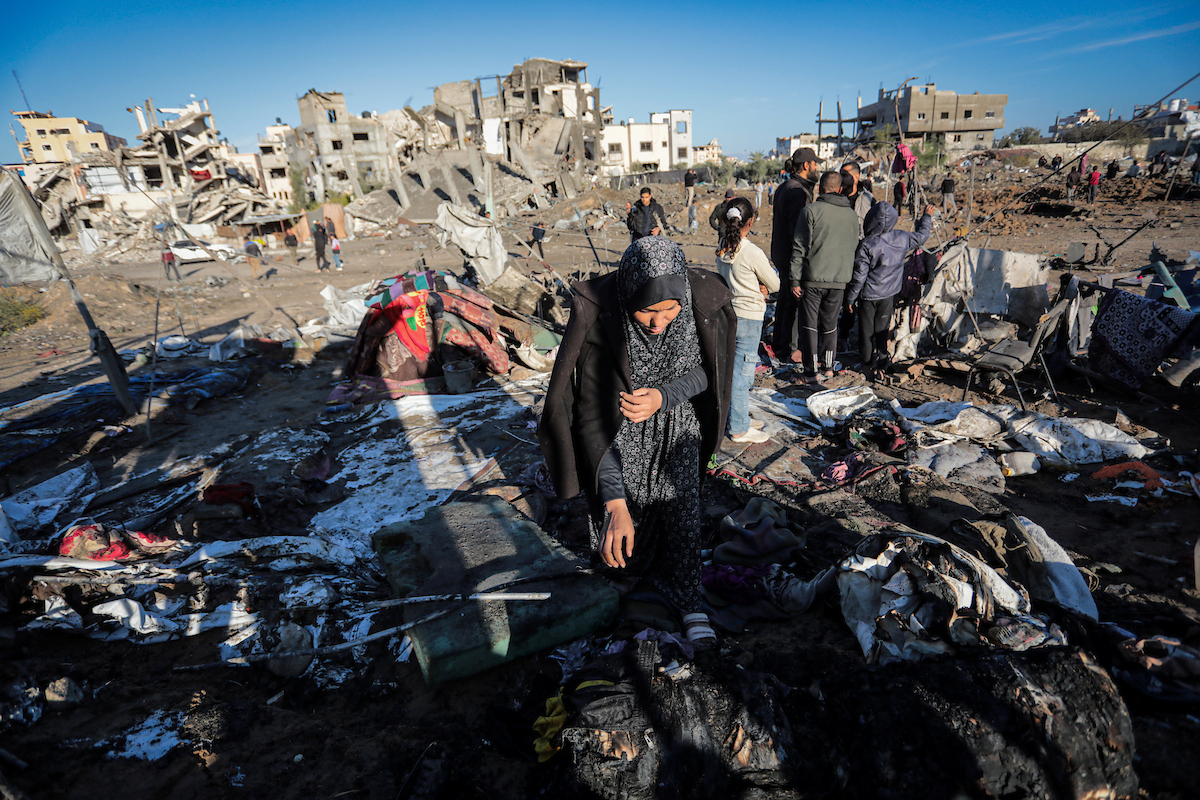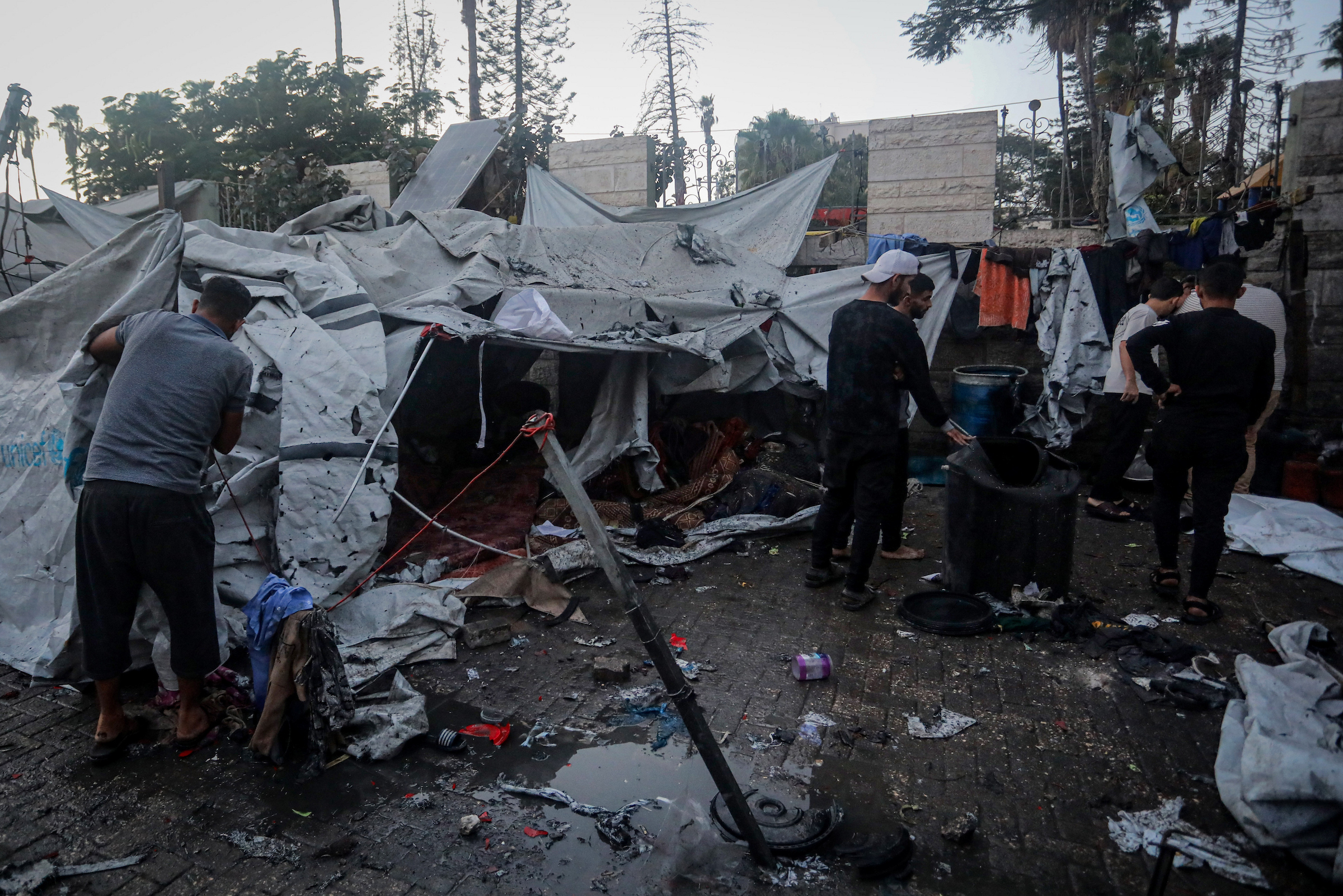
Around 2 million Palestinians in the Gaza Strip are enduring dire humanitarian conditions, forced to live in worn-out tents, makeshift shelters, and damaged buildings at risk of collapse, with none providing even the most basic protection or safety. As winter sets in and successive storms batter the Strip, their suffering intensifies, placing their lives at even greater risk. This is compounded by Israel’s continued restrictions on the entry of tents, shelter supplies, and construction materials, as well as its obstruction of reconstruction efforts, preventing hundreds of thousands of Palestinians from accessing safe and adequate shelter.
The Palestinian Centre for Human Rights (PCHR) warned that the continued deprivation of displaced Palestinians of shelter materials and basic means of protection against the cold and rain is forcing them to endure unsafe living conditions, turning every incoming low-pressure system into a potential humanitarian catastrophe that threatens their lives and safety. PCHR stressed that the continuation of these conditions, amid Israel’s restrictions on the entry of humanitarian aid and essential supplies, reflects an ongoing disregard for the provisional measures ordered by the International Court of Justice (ICJ), particularly those requiring the provision of basic services and humanitarian assistance and the adoption of all necessary measures to prevent the deterioration of living conditions that threaten the lives of the Palestinian population in the Gaza Strip.
These risks are compounded by the severe gap between the needs of Gaza’s population, and the shelter supplies currently available. Estimates by international organizations indicate the Gaa population’s need to around 121,000 amid 561,000 tarpaulins, 57,000 emergency shelter kits (ESKs) and 1.7 million mattresses ahead severely depleted stocks in Gaza, which currently comprise approximately 2,800 tents, 76,000 tarpaulins, 4,993 mattresses, while no ESKs are available. This stark shortfall underscores the urgent need to immediately allow the entry of available shelter supplies to provide displaced Palestinians with even the most basic protection.1
PCHR stresses that the continued imposition of humiliating and inhumane living conditions on hundreds of thousands of displaced Palestinians, coupled with their deliberate deprivation of adequate shelter and basic means of protection against cold and rainy weather, while forcing them to remain in worn-out tents and damaged buildings at risk of collapse, constitutes, taken as a whole, the deliberate infliction of conditions of life calculated to bring about the physical destruction of the Palestinian population in the Gaza Strip, in whole or in part. This falls under the third prohibited act set out in Article II(c) of the 1948 Convention on the Prevention and Punishment of the Crime of Genocide (Genocide Convention).
Although a year has passed since the ceasefire was declared on 10 October 2025, there has been no tangible improvement in the conditions of displaced Palestinians. On the contrary, acts of genocide have continued, and the humanitarian catastrophe has further deteriorated.
The so-called “Trump Peace Plan” has likewise failed to bring about any meaningful improvement. Reconstruction remains obstructed, with construction materials, including cement, still barred from entering the Gaza Strip. Not a single bag of cement has entered the Strip since the announcement of the plan. PCHR considers that, rather than paving the way for peace or bringing an end to civilians’ suffering, the plan has provided political cover for Israel’s continued crimes. PCHR further warns that the United States’ continued support for these policies, despite their involvement in grave violations of international law, engages the responsibility of the US administration for the ongoing crimes against Palestinian civilians.
United Nations reporting highlights the stark contradiction between Israeli claims of allowing shelter supplies into the Gaza Strip and preparations for the winter season, and the actual humanitarian conditions on the ground. According to an OCHA report published on 9 November 2026, more than 150,000 tents procured by humanitarian partners and Member States outside the Gaza Strip are ready for dispatch. These include approximately 117,000 tents stockpiled in al-Arish alone, in addition to 300,000 tarpaulins and 500,000 blankets. The report further noted that humanitarian efforts to prepare for winter had been hampered by funding shortfalls and Israeli restrictions on the entry of essential supplies and equipment, including vacuum trucks, mobile dewatering pumps, spare parts, and heavy machinery. This demonstrates that the worsening suffering of displaced Palestinians is not attributable solely to shortages of humanitarian assistance, but also to the obstruction of the delivery of supplies that are already available and ready for dispatch. As a result, hundreds of thousands of displaced Palestinians remain without adequate protection against the cold, rain, and flooding.2
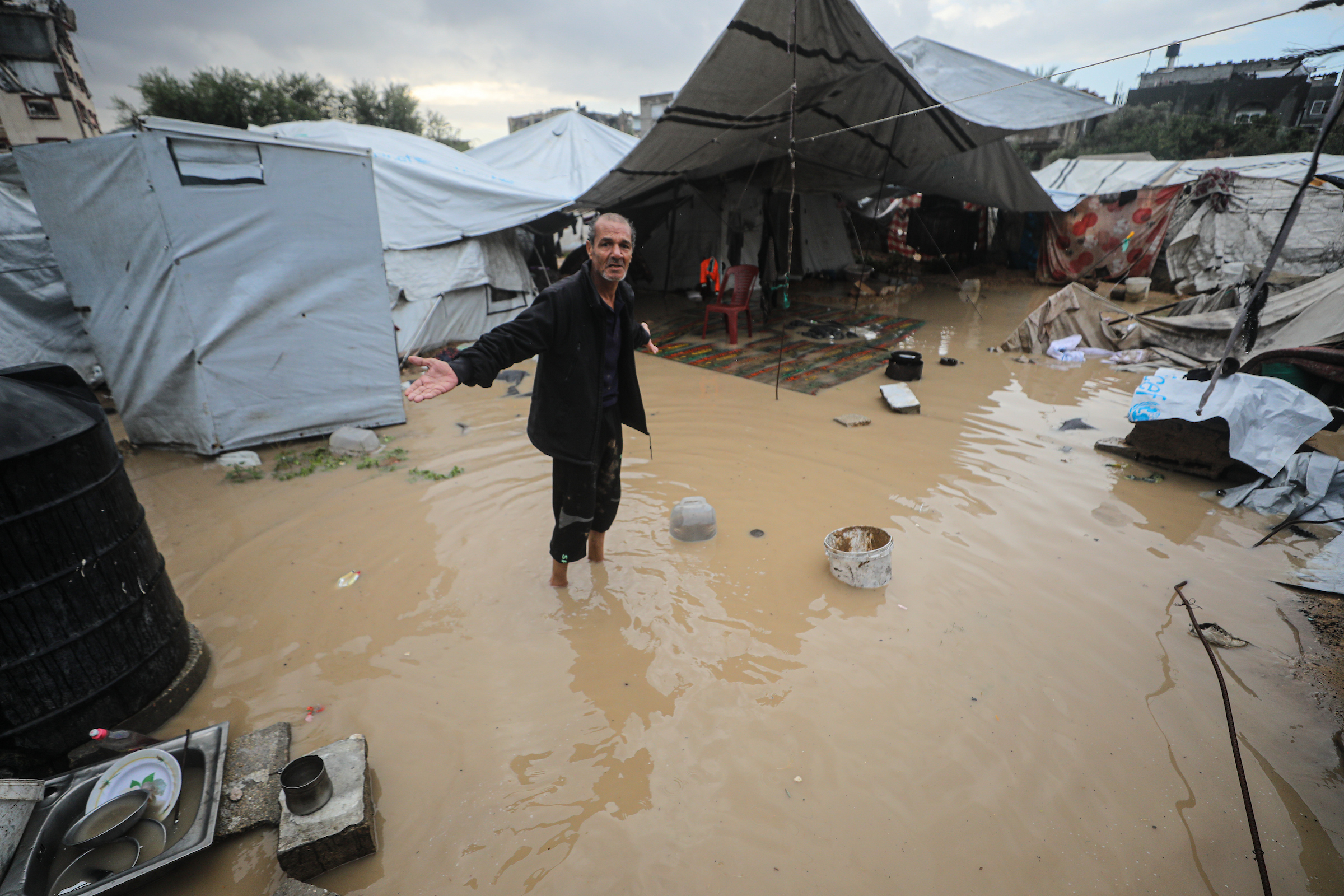
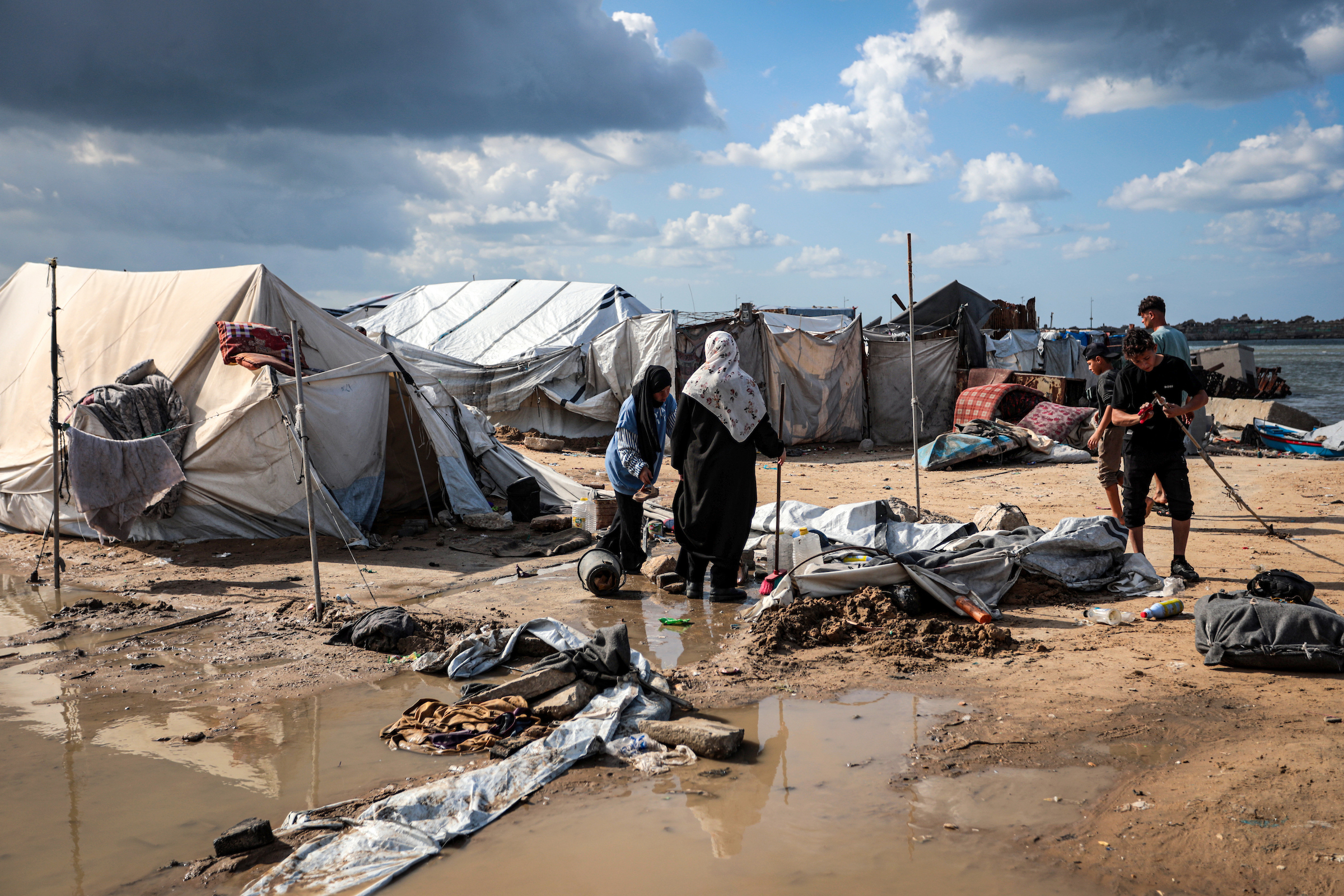
The first low-pressure system of the winter season struck the Gaza Strip between Friday afternoon, 6 November, and Sunday, 8 November 2026, exposing the extremely dire living conditions of displaced Palestinians and the severe lack of basic protection measures. Rainwater flooded tens of thousands of tents and displacement sites, damaging families’ belongings and drowning roads. The heavy rainfall also heightened the risk of collapse of damaged buildings and sand embankments, resulting in casualties, including women and children. These risks are compounded by Israel’s continued restrictions on the entry of fuel, equipment, and vehicles needed to drain rainwater, reopen roads, and address water accumulation. These restrictions undermine emergency response teams’ ability to respond to distress calls, reach affected areas, and carry out life-saving interventions. This comes following Israeli attacks targeting Civil Defense and municipal headquarters and vehicles, as well as personnel and vehicles belonging to companies working to repair water and sanitation networks. These attacks have further weakened emergency response capacities and heightened the imminent threats to the lives of the population.
According to the follow-up by PCHR’s field researchers, tents erected in low-lying areas, on sandy ground, and in open spaces were among the shelters most severely affected by the storm. As a result of the heavy rainfall, water flooded large numbers of tents and accumulated in living and sleeping areas, soaking bedding, blankets, mattresses, clothing, and personal belongings. It also damaged food supplies and household essentials belonging to displaced families, many of whom have no means of replacing what they have lost. Some families had no choice but to seek shelter temporarily at relatives’ houses or nearby areas, remain in the open or trying to protect their tents by primitive means amid limited alternative shelters.
According to the Government Media Office in the Gaza Strip, rainfall flooded 70,000 tents sheltering tens of thousands of displaced Palestinians, while dozens of walls collapsed across the governorates of the Gaza Strip, causing injuries, some of them serious.3 Meanwhile, OCHA reported that approximately 46,000 households (226,000 people) were affected, with more than 40,000 family shelters sustaining damage. More than 9,000 shelters were reportedly destroyed beyond repair while thousands of displaced Palestinians were forced to spend the night without shelter.4
In a tragic incident highlighting the dangers posed by unsafe displacement sites, large sand embankments collapsed onto several tents sheltering displaced Palestinians at around 19:30 on Sunday, 8 November 2026, at al-Ribat Shelter Camp, south of the al-Hawouz area in Deir al-Balah. The collapse killed four people, including a seven-months-pregnant woman and her two children, as well as another child. A woman and her child also sustained serious injuries. Those killed were identified as Tahreer ‘Abdullah Ibrahim Nabhan (35), her two children, Salah Ahmed Khaled Nabhan (8) and Mariam Ahmed Khaled Nabhan (5), and Habibah Hussam Talal al-Zain (4). Meanwhile, Mariam ‘Abdullah Ibrahim al-Zain (40) and her child, Ibrahim Hussam Talal al-Zain (14), sustained serious injuries.
Regarding the circumstances of the incident, Mahmoud Dweidar, a representative of al-Ribat Camp,5 told PCHR’s field researcher that the camp is located in a low-lying area, approximately seven meters below the surrounding ground level, and is enclosed by sand berms on all four sides, exposing it to the risk of collapse, particularly during rainfall. He added that the area experienced heavy rainfall and that, just minutes after the rain stopped, the sand embankments collapsed onto several tents on the western side of the camp, mainly two tents sheltering two families of four members each. Family members recounted how they had been buried under the sand, prompting other camp residents to rush to their rescue. Using simple tools, they managed to dig through the sand, recover the bodies of a woman and three children, and pull out another woman and her child, who had sustained serious injuries. Ambulance and Civil Defense teams arrived approximately 45 minutes later and began evacuating the victims and injured people to hospitals.
This incident underscores that depriving Palestinians of adequate shelter and essential shelter materials not only exacerbates their already dire living conditions but also exposes their lives to immediate danger, placing them at risk of death whenever storms or heavy rainfall occur. Displaced Palestinians are left with no choice but to remain in displacement sites that fail to meet even the most basic safety and protection standards.
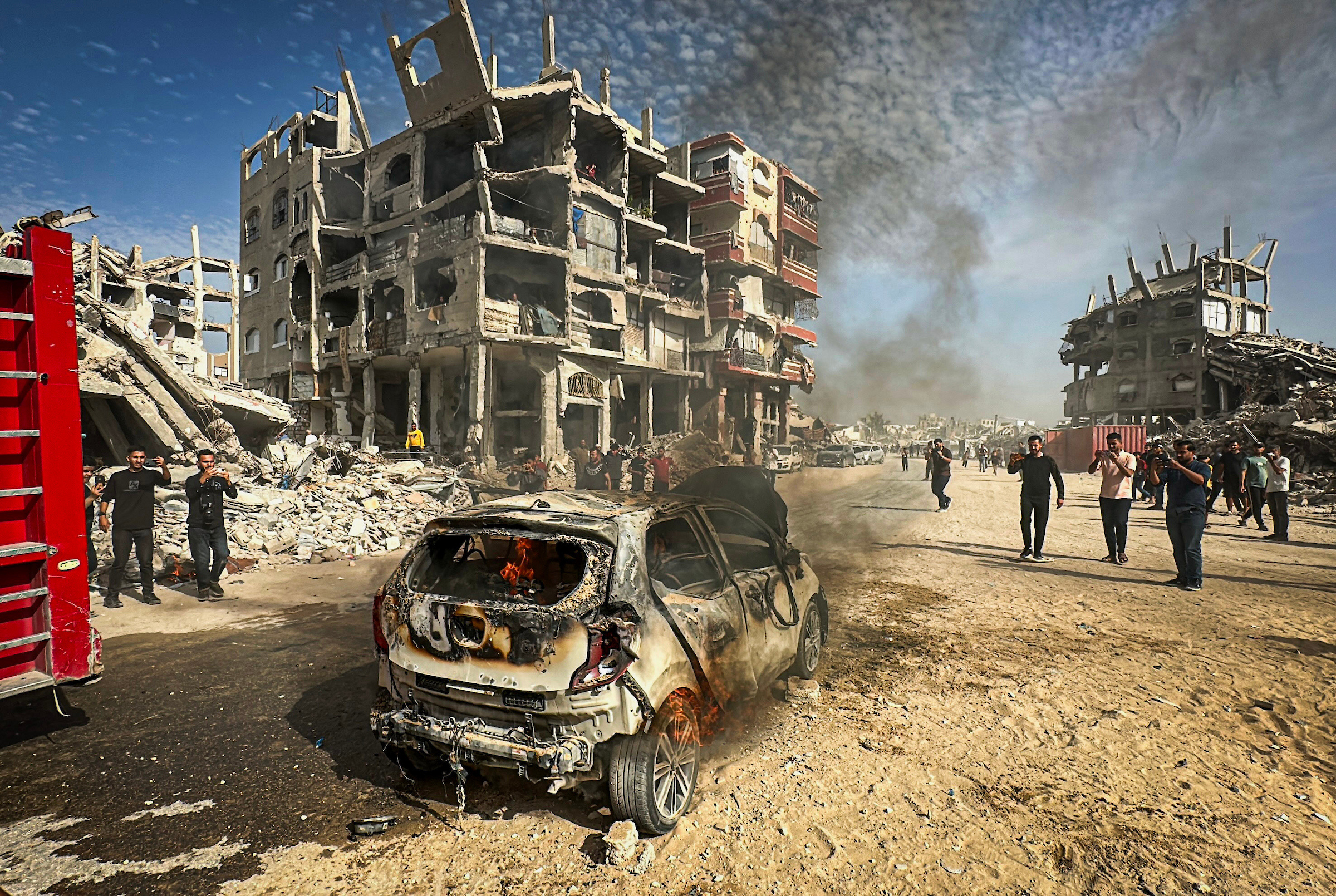
The impact of the low-pressure system also extended to families sheltering in homes and buildings damaged by previous Israeli bombardment, who were forced to remain in or return to these buildings in the absence of safe alternative accommodation and because they could not afford rental costs. Heavy rainfall and strong winds further heightened the risk of these buildings collapsing, as rainwater flooded their interiors and exacerbated existing damage and structural cracks in walls, ceilings, and supporting columns.
PCHR’s field researchers documented six incidents involving the collapse of buildings or parts thereof across the Gaza Strip. One of these incidents resulted in injuries among civilians when a previously damaged building wall collapsed in Beit Lahia. In one of these incidents, 64-year-old Tamador Khamis Suleiman al-Saloul told a PCHR’s field researcher6 that she lives with her family in a three-storey house near al-Ahli Club, west of Nusseirat Refugee Camp. Three families of total 20 people live in the house, which according to her was bombed by IOF on 13 December 2024 and was partially destroyed and severely damaged, rendering it at risk of collapse, particularly on its western side. With no alternative shelter available, the three families were forced to repair parts of the eastern side of the house and continue living there despite the danger posed by the building’s dangerous condition.
She added that, on the afternoon of Friday, 6 November 2026, heavy rain and strong winds caused rainwater to flood the house. At around 05:00 the following morning, family members were awakened by the sound of stones falling and parts of the western side of the house collapsing. They were forced to flee immediately, without having time to retrieve their belongings or even their basic necessities. At around 06:30, a large section of the western side collapsed onto the street. No casualties were reported. She confirmed that a Civil Defense team inspected the house and warned that its condition posed a serious threat to the lives of its occupants, urging the families to evacuate immediately for fear that the building could collapse entirely. The families wish to comply with the warning but have nowhere else to go, leaving the 20 people living in the house facing an impossible choice: homelessness or remaining in a building at risk of collapse.
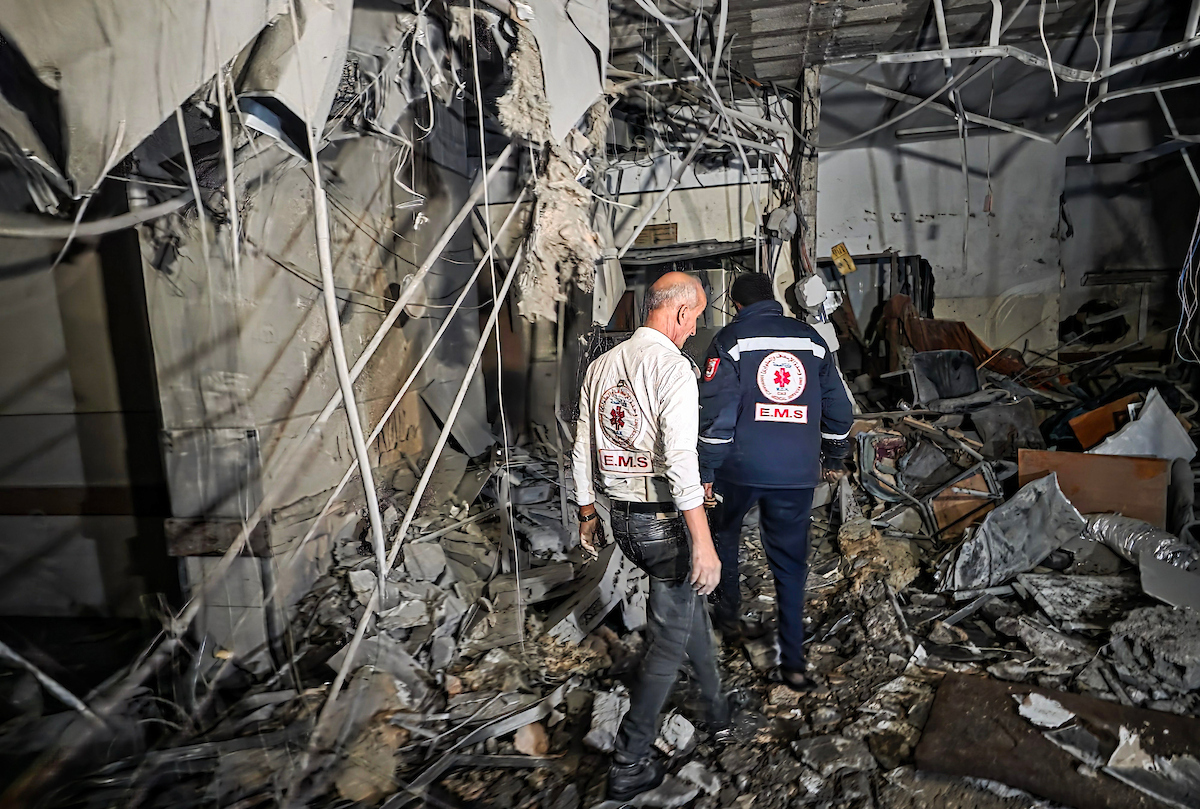
These incidents highlight the grave risks facing Palestinians who are forced to remain in damaged and unsafe buildings in the absence of alternative housing. The situation is further exacerbated by the lack of resources needed to assess the structural safety of these buildings, carry out repairs to those that can be made safe, and evacuate those at imminent risk of collapse. These risks increase during periods of heavy rainfall, as water wet through the soil and further undermines the stability of already damaged structures. This is particularly alarming given repeated warnings by Civil Defense teams and the relevant authorities that thousands of damaged buildings remain at risk of collapse.
Rainfall also caused water to accumulate inside shelters, in residential areas, and around them, with the standing water mixing with wastewater in some locations. This has heightened public health risks and the threat of disease outbreaks, while obstructing displaced Palestinians’ movement and hindering ambulances, Civil Defense teams, and relief workers from reaching affected areas. The crisis has been further exacerbated by Israeli restrictions on the entry of heavy vehicles and essential equipment used to vacuum accumulated water, dewatering pumps, as well as fuel and spare parts. These restrictions severely limit the ability of municipalities and Civil Defense teams to respond, particularly amid the widespread destruction of infrastructure and the damage to their equipment.
The Civil Defense in Gaza reported receiving 2,166 distress calls from people whose homes and tents had been flooded. Its teams, working in coordination with other relevant bodies, were able to handle only 218 of these calls. In many other cases, their response was limited to providing instructions over the phone, as they were unable to reach those affected on the ground.7
In a statement to PCHR’s field researcher,8 a member of the Civil Defense team said that most distress calls concerned flooded tents, blocked roads, and fallen electricity poles and trees. The teams’ interventions included pumping out accumulated water, removing sources of danger, towing stuck vehicles, transporting patients, and evacuating displaced Palestinians from areas at risk of flooding. He added that shortages of water vacuum pumps and essential rescue equipment, including cutting and breaking tools and generators, had forced teams to rely on limited hand tools. He further explained that precautionary measures, such as erecting sand barriers and placing sandbags, provided only temporary protection and did not address the underlying lack of infrastructure or access to the essential materials needed to ensure safe shelter.
In an interview with Mahmoud Ahmed ‘Abdel Khaleq Abu T’eimah, Manager of the al-Fajr Shelter Camp Complex,9 he reported that the complex accommodates approximately 1,099 displaced families across four camps. He explained that the low-pressure system caused water to accumulate at the complex’s entrances, blocking access. Displaced residents were forced to dig trenches to drain the water; however, access remained difficult for two days, disrupting residents’ movement and the delivery of humanitarian aid. A total of 245 tents were damaged, including 10 that were completely destroyed, while the rest sustained partial damage. The impact extended to around 1,222 people, as water seeped into the tents and damaged mattresses, blankets, clothing, and household items. This further compounded their suffering and increased their exposure to cold and damp conditions, particularly among the most vulnerable groups. Abu T’eimah highlighted the urgent need for other tents and materials to repair damaged ones, as well as blankets, mattresses, and winter clothing. He also stressed the need for a high-capacity water pump, a 100-metre discharge pipe to drain accumulated water towards the sea, and tools to clear drainage channels. He emphasized that aid distribution should prioritize families with children, women, older persons, patients, and persons with disabilities.
At the economic and livelihood levels, the low-pressure system has further compounded the burdens endured by displaced families, who already face a lack of income sources and a declining ability to meet their basic needs. Many families were forced to spend their remaining savings or borrow money to purchase tarpaulins, nylon sheeting, ropes, and other materials to repair their tents. Others lost mattresses, blankets, clothing, and their already limited food supplies after rainwater seeped into and flooded their shelters. Field testimonies collected by PCHR illustrate the scale of the losses sustained by these families. Some were even forced to leave their shelters and seek refuge in temporary locations that lack the most basic shelter necessities.
In a testimony documenting the impact of the low-pressure system, ‘Abeer Yousif Jadou’a Abu T’eimah (36),10 a displaced woman from ‘Abasan al-Kabirah, said that her husband had left the Gaza Strip nine months earlier to receive medical treatment abroad for injuries he had sustained, leaving her as the sole breadwinner for their six children. She explained that she and her children live in a caravan-like structure covered with a tarpaulin, with only two mattresses, two blankets, and a few kitchen utensils. At around 02:00 on Saturday, 7 November 2026, rainwater seeped into and flooded the shelter, soaking their belongings and forcing her and her children to flee. They initially sought temporary shelter in the camp’s activities room before moving to her brother’s tent. She added that the caravan had become uninhabitable and that she had been unable to return. She and her children continue to stay with her brother. She called for the provision of a tent or tarpaulins to enable her to repair her shelter and return to it.
In a particularly severe incident, displaced Palestinian ‘Abdullah Yousif Jadou’a Abu Hammad (44)11 said that he and his family of nine, including five children, have been living at al-Fajr al-Modee’a Camp for the past year and a half. He explained that, at dawn on Saturday, 7 November 2026, heavy rainfall caused their tent to collapse while the family was inside, and rainwater flooded it. Young men from the camp had to intervene to pull the family out. The incident left his son Zaher (21) with a head injury and his son Mohammed (9) with bruises to his right foot. He added that floodwater swept the tent several meters away from its original location and damaged their mattresses, blankets, clothing, and food supplies, as well as their lighting floodlight and its electrical control panel. He stressed that his family is now unable to withstand further storms or rainfall, particularly given the deteriorating shelter conditions and the absence of assistance.
Meanwhile, displaced Palestinian Na’im Hussein Abu T’eimah (48)12 said that he lives with his family of six in a tent consisting of a wooden frame covered with tarpaulins. He explained that, at around 02:00 on Saturday, 7 November 2026, his family was awakened by the sound of the wooden frame breaking and the tarpaulin collapsing, forcing them to flee the tent and seek shelter in a nearby prayer hall. However, the prayer hall was also flooded, forcing them to move to the camp’s activities room, where they remained until morning. He added that, upon returning, he found the tent completely destroyed, reduced to a pile of broken wooden pieces and torn tarpaulins. Their mattresses and blankets had also been damaged by the floodwater. He said he had to buy wood, tarpaulins, and nylon sheeting to rebuild the tent, stressing that his family had received no assistance, including shelter supplies.
In another testimony, displaced Palestinian Isma’il Jom’ah Isma’il Abu T’eimah (56)13 said that he lives with his family of four in a tent consisting of a wooden frame covered with tarpaulins. He added that his family shares a toilet with several other families. He explained that, at dawn on 7 November 2026, he was forced to leave the tent after rainwater flooded it and seek shelter in a nearby prayer hall, which was also flooded. He and other affected families subsequently moved to the camp’s activities room. He added that, upon returning to the tent, he found that their mattresses, clothing, and food supplies had been soaked by rainwater. Expressing concern that further storms could expose his family to the same dire conditions, he called for the provision of tarpaulins, tents, and nylon sheeting to protect displaced families.
Displaced Palestinian Suzi Mahmoud Ahmed Abu T’eimah (47)14 also reported that her husband has been detained since 7 October 2023 and that she has been living in the camp since 18 May 2024 with her four-member family in a separate tent, located near the tent of her married son, Ahmed Yasser Abu T’eimah (25). She explained that, at dawn on 7 November 2026, rainwater seeped into her tent, forcing her son to dig a pit beside it to collect the water and prevent further flooding. She added that the rainfall soaked their mattresses, blankets, and clothing and ruined the flour they had. She further stated that she was forced to borrow 700 shekels from acquaintances to buy plastic sheeting, which she and her family used to repair and re-cover the tent’s roof in an attempt to provide themselves with even the most basic protection from the rain.
PCHR considers that the continued deterioration of the humanitarian conditions of displaced Palestinians, amid Israel’s restrictions on the entry of shelter supplies and materials needed to protect them from adverse weather conditions, constitutes a violation of Israel’s obligations under international humanitarian law and international human rights law. Under the 1949 Fourth Geneva Convention, Israel, as the occupying Power, is obligated to respect protected persons and ensure that they are treated humanely (Article 27); ensure the provision of essential supplies to the population (Article 55); and maintain medical and hospital establishments and services, as well as public health and hygiene (Article 56). Article 59 further requires the occupying Power to agree to and facilitate relief schemes by all the means at its disposal and to permit the free passage of relief consignments when the population is inadequately supplied. Accordingly, obstructing the entry of shelter materials and supplies needed to protect the population from cold and rain, and impeding the delivery of humanitarian assistance, constitute breaches of these obligations.
The deliberate imposition of conditions of life calculated to bring about the physical destruction of a population, in whole or in part, through the deprivation of shelter, food, water, and medical care, falls within the third prohibited act set out in Article II(c) of the Genocide Convention, provided that it is accompanied by the specific intent to destroy the protected group, in whole or in part. Depending on the circumstances and the fulfilment of the relevant legal elements, such acts may also amount to individual criminal responsibility under the Rome Statute of the International Criminal Court, particularly under Article 7, concerning crimes against humanity, and Article 8, concerning war crimes. These include, subject to the conditions set out in the Statute, using starvation of civilians as a method of warfare and depriving them of objects indispensable to their survival. Under international human rights law, the continued deprivation of displaced persons of adequate shelter and protection from severe weather conditions, and the resulting health and living risks, constitute violations of the right to an adequate standard of living, including adequate food, clothing and housing, and the right to the enjoyment of the highest attainable standard of physical and mental health, as enshrined in Articles 11 and 12 of the International Covenant on Economic, Social and Cultural Rights (ICESCR).
Thus, PCHR calls on the international community to compel Israel, as the occupying Power, to lift the restrictions imposed on the entry of shelter supplies and winter necessities into the Gaza Strip, and to ensure the immediate and adequate entry of such supplies. These must include tents, tarpaulins, blankets, mattresses, winter clothing, water drainage equipment, heavy vehicles, fuel, and spare parts required to repair sanitation and rainwater drainage networks. PCHR further calls for municipal and Civil Defense teams to be enabled to carry out their duties effectively. PCHR also calls on the United Nations and its humanitarian agencies to intensify their winter response, provide the resources required to meet the population’s needs, and facilitate the entry of supplies already available outside the Gaza Strip.