The Palestinian Centre for Human Rights (PCHR) strongly condemns the Israeli Occupation Forces’ (IOF) imposition of collective punishment and widespread retaliatory measures against Palestinian civilians in Hebron, in the southern West Bank. These measures include closing the city’s entrances, isolating its neighborhoods, demolishing homes and commercial facilities, confiscating vehicles, and forcibly displacing hundreds of families from their homes, alongside mass arrest campaigns and attacks on civilians.
PCHR stresses that these measures are part of a recurring Israeli policy aimed at undermining the very presence of Palestinians by tightening restrictions on residents, destroying their property, forcibly displacing them from their homes, and imposing a coercive reality that erodes their fundamental rights. PCHR further emphasizes that exploiting the shooting incident near the city’s northern entrance to justify collective punishment, the forced displacement of residents, and the destruction of their property provides no legal basis for these violations and does not absolve Israel of its obligations towards the civilian population, who are protected persons under international humanitarian law.
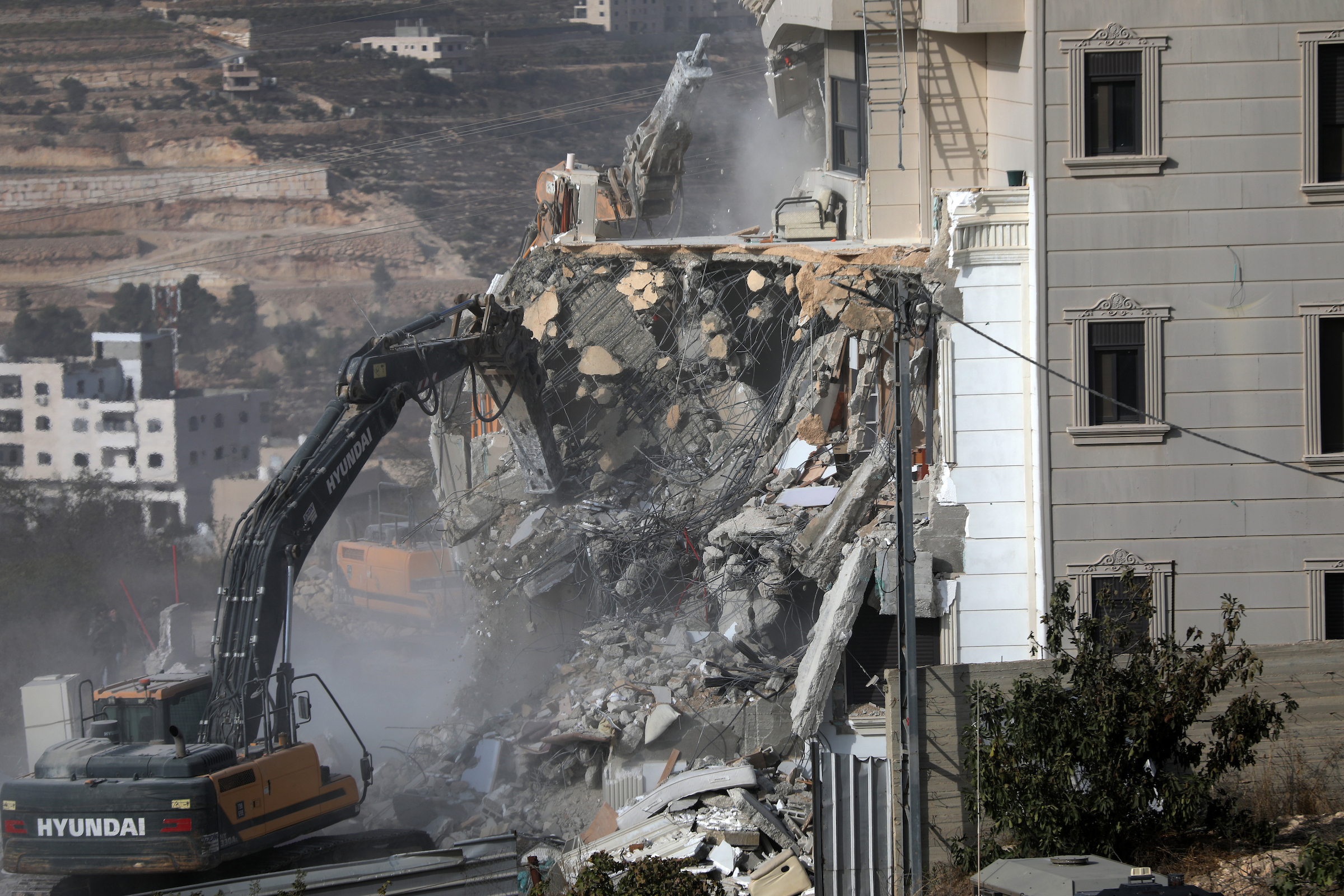
According to information collected by PCHR’s field researchers, a large force of IOF stormed Hebron at around 08:00 on Friday, 23 October 2026, closed the city’s main and secondary entrances, and imposed restrictions on movement, fragmenting the city center and isolating it from surrounding towns and villages. These measures followed a shooting incident near the city’s northern entrance, adjacent to Bypass Road 35, in which two Palestinians from the al-Ja’bi family and two Israeli soldiers were killed. Approximately an hour and a half after the incursion began, IOF military reinforcements arrived in the Farsh al-Hawa area, near the northern entrance and the bypass road, accompanied by excavators and bulldozers. The IOF proceeded to demolish and raze civilian property and facilities, including a 17-dunum plot used as a yard by a tile and ceramics business owned by the al-Qawasmi family. IOF demolished the walls surrounding the yard and a three-storey house belonging to Riyadh ‘Ezzam Mahmoud Imreish, despite his having obtained an interim court order following an earlier notice issued by the Israeli Civil Administration. IOF also demolished a commercial facility selling automobile spare parts. IOF confiscated all vehicles parked in the yard and garage and loaded them onto trucks, taking them to an unknown destination. The IOF also completely closed the road and prevented the owners from accessing their properties as demolition and razing operations continued.
At around 23:30 on the same day, additional IOF reinforcements arrived in the areas of Deir Bahah, Khabbab Intersection, and al-Jeldah Intersection. IOF began ordering residents over loudspeakers to evacuate their homes immediately. Families were forced to gather whatever belongings they could and leave the area, which IOF completely sealed off, setting up military checkpoints at all exits and intersections leading out of the area and subjecting vehicles and residents fleeing on foot to searches.
One resident told PCHR’s field researcher that he had evacuated his home with his family after hearing the evacuation orders. IOF stopped them at one of the intersections, searched his vehicle, and checked his identity card before allowing them to proceed, without informing them when they would be permitted to return home. He said that he and his family were now staying at a relative’s house. He added that IOF had told some residents they would remain in the area for several days, while others were told that the measures could last six months. These conflicting statements have heightened fear and uncertainty among families forced to leave their homes without knowing when they would be able to return.
According to initial estimates released by Hebron Municipality, IOF forcibly displaced approximately 500 families, comprising around 2,500 people, from their homes within an area spanning approximately 350 dunums, as outlined in a map published by the Municipality. At the time of writing, the area remains under strict military restrictions imposed by IOF, amid continued raids and searches of homes. During these operations, IOF ransacked the contents of houses and placed flags on homes they raided, marking each house with a red sign once the search had been completed.
At dawn on Saturday, 24 October 2026, IOF launched a widescale arrest campaign across Hebron city center and nearby villages, towns, and refugee camps, detaining dozens of Palestinians and taking them to IOF’s military camps and centers on the outskirts of the city for interrogation. Several detainees were released in the early hours of the morning.
M. Sh. told PCHR’s field researcher that IOF raided his home in the city center at around 01:00 and took him to a military vehicle holding several other detainees. They were then transferred to a military post near the entrance to al-Fawwar refugee camp, south of Hebron. He said he was held there until 07:00, during which several detainees were assaulted and soldiers threatened them before releasing them at the same location.
PCHR expresses grave concern over the expanding scope of Israeli measures in Hebron, their rapid escalation within less than 24 hours, and reports that some residents were told the restrictions could remain in place for six months. These developments raise serious concerns that the measures could establish a precedent for similar actions across cities and villages throughout the West Bank, particularly amid repeated threats by senior Israeli political officials to impose comparable measures elsewhere.
PCHR stresses that the ongoing situation in Hebron cannot be viewed in isolation from the broader context of Israeli policies across the West Bank, including home demolitions, the forced displacement of Palestinian communities, settlement expansion, closures, and restrictions on freedom of movement. In its advisory opinion of 19 July 2024, the International Court of Justice (ICJ) concluded that Israel’s continued presence in the Occupied Palestinian Territory is unlawful. ICJ held that Israel is under an obligation to bring its unlawful presence in the Occupied Palestinian Territory to an end, immediately cease all settlement activity, and repeal all legislation and measures maintaining the unlawful situation.
Accordingly, PCHR calls on the international community to take urgent action to exert pressure on Israel and compel it to immediately end all measures of collective punishment imposed on Hebron and its residents; repeal evacuation orders; enable families to return safely to their homes; lift the closures imposed on the city’s entrances and roads; halt demolitions and razing operations; and cease the confiscation of vehicles and property.
PCHR calls on all High Contracting Parties to the four Geneva Conventions to fulfill their obligations under Common Article 1 to respect and ensure respect for the Conventions in all circumstances. This requires them to take concrete measures to bring ongoing violations to an end, ensure respect for and protection of Palestinian civilians and their property, bring Israel’s unlawful occupation to an end and ensure the Palestinian people’s exercise of their inalienable rights, including the right to self-determination.