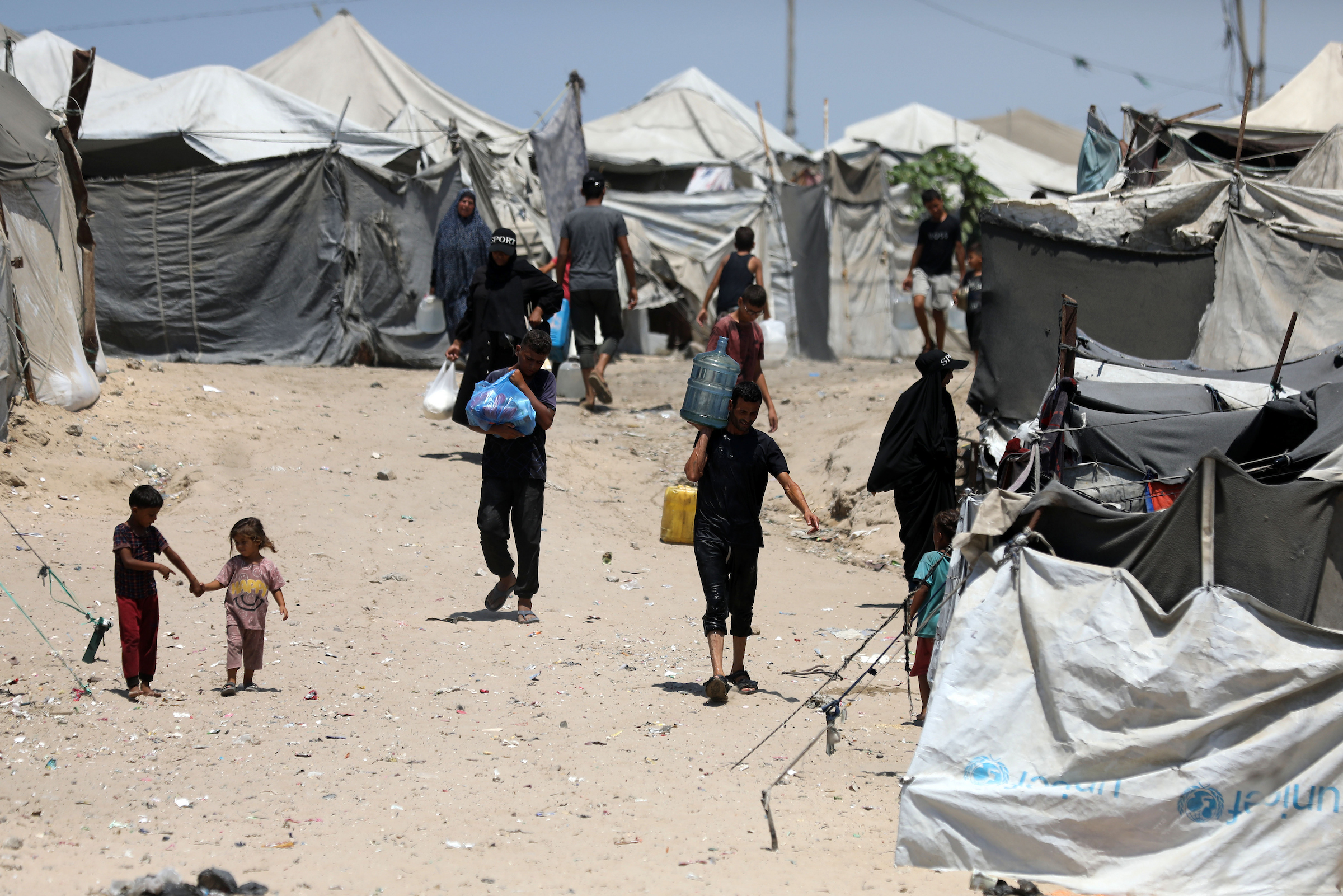
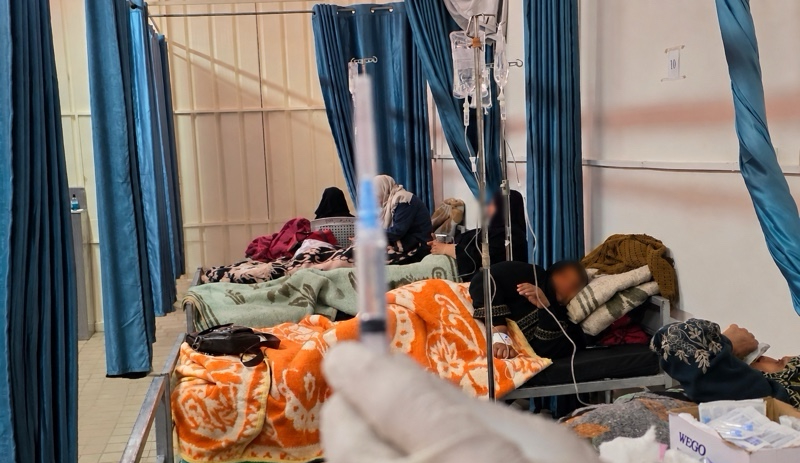
Hundreds of thousands of Palestinians in the Gaza Strip continue to live in worn-out tents and makeshift shelters following the destruction of their residential neighborhoods and their forced displacement as a result of Israeli military operations and repeated displacement orders. Displaced Gazans are facing increasingly harsh living conditions, deprived of the right to return to their places of residence and lacking the minimum essentials required for a dignified life in displacement sites. Tents, initially intended as temporary shelters, have effectively become long-term places of residence, amid severe shortages of water, food, medicine, and shelter materials, alongside the deterioration of sanitation and healthcare services. This situation is compounded by the continued targeting and destruction of infrastructure and civilian facilities, as well as tightened restrictions on the entry of essential humanitarian aid and reconstruction materials into the Strip. To date, not a single bag of cement has been allowed to enter the Gaza Strip.
The Palestinian Centre for Human Rights (PCHR) underscores that these circumstances are neither incidental nor temporary, but form part of a broader context of policies aimed at deliberately undermining the conditions necessary for the survival and stability of Gaza’s population and depriving them of essential conditions for a dignified life and for the right to return to their places of residence. PCHR emphasizes that the convergence and systematic accumulation of these measures form part of an Israeli plan to forcibly displace the entire population of the Gaza Strip, particularly amid ongoing, successive, and repeated statements by Israeli officials calling for or encouraging the displacement of Palestinians from Gaza as a solution to the crisis engulfing the Strip. The latest of these statements was by Israeli Prime Minister Benjamin Netanyahu, who called on the international community to allow Palestinians in the Gaza Strip to leave, claiming that some states refuse to receive Palestinians from Gaza so as not to “help Israel.”1 Viewed from this Israeli perspective, confining displaced Palestinians to extremely perilous living conditions, destroying their homes, preventing their reconstruction, depriving them of essential services and basic necessities, and continuously exposing them to danger, bombardment, and death contribute to creating an environment that gradually compels Palestinians to seek safety and security outside the Gaza Strip.
In the Gaza Strip, approximately 2.17 million people are now confined to an area that does not exceed 30 per cent of the Strip’s total territory, amid ongoing and widespread forced displacement. The findings of an assessment of displacement sites2 conducted by the Site Management Cluster (SMC)3 demonstrate the scale of this crisis, indicating that 1,591 assessed sites across the Gaza Strip’s governorates accommodate an estimated 1,708,822 people in 354,550 households. The assessment identified 1,591 active sites, 83 per cent of which are makeshift sites, meaning informal, open-air, and tented locations lacking essential services and infrastructure. Collective centers, including schools and public buildings, account for approximately 11 per cent of the sites, while the remaining population is dispersed across scattered residential areas. These figures do not merely reflect the extensive scale of a temporary or emergency humanitarian crisis; rather, they reveal how displacement has been transformed into a prolonged and enduring reality imposed on hundreds of thousands of families who have lost their homes or been prevented from returning to them. This is taking place amid the continued destruction of infrastructure essential for survival, thereby further exacerbating the vulnerability of displaced Palestinians, making their continued survival under such conditions increasingly difficult, and creating conditions that compel the population to leave. This reflects what the Israeli occupation seeks to achieve through the policies it has implemented since 7 October 2023, as PCHR has repeatedly warned of since the onset of Israel’s military aggression against the Gaza Strip.
The situation on the ground reveals a serious deterioration in shelter conditions, as thousands of tents have been damaged due to prolonged use and harsh weather conditions, rendering them increasingly incapable of protecting displaced families from the summer heat, winter rain, and strong winds. The covers of many tents have been torn, while their flooring has deteriorated, forcing families to patch them with pieces of nylon or used cloth. In another serious indicator, approximately 7,700 families, comprising around 38,500 individuals, are sleeping in the open air within displacement sites without access to tents or other forms of shelter. Meanwhile, more than 136,000 families, comprising approximately 680,000 individuals, have been deprived of any form of shelter assistance over the past six months. Overcrowding further exacerbates these conditions. An average of six people occupy each tent, although humanitarian tents are designed to accommodate five people. Moreover, more than eight people are living in over 59,000 tents, depriving families of even the minimum standards of privacy and increasing social and psychological pressures, as well as protection risks faced by women, children, and girls.
Mohammed Abu ‘Odah (58),4 a displaced person living with his family of 8 in a tent in western Gaza City, describes his ordeal to PCHR’s researcher as follows: “This is no longer a tent, but merely a piece of cloth that barely shelters us. My family and I are exposed to unbearable heat every day. The tent turns into an oven, and my children nearly faint from the extreme heat. At night, it does not protect us from rodents and insects, so I stay awake to protect my family from rodents that sneak through the tent’s torn sides. In winter, things were no better. Rainwater flooded the tent several times, soaking our mattresses, blankets, and clothes. The tent is too small to accommodate eight people. My children sleep huddled together on the ground in a deeply degrading condition. For months, our tent has become worn-out, yet no organization has provided us with a new tent. I cannot afford to buy another one, as it costs around US$1,500–2,000—an amount I simply cannot afford, as I have been unemployed for more than two years.”
The suffering of displaced Palestinians in the Gaza Strip is not only limited to the lack of safe and adequate shelter; it is compounded by the ongoing collapse of water, sanitation, and hygiene services at displacement sites, turning them into extremely vulnerable and contaminated environments that threaten the health, well-being, safety, and human dignity of the population on a daily basis. Most of these sites rely on water tankers to supply potable water amid the damage to or destruction of large parts of the water networks. As a result, displaced Palestinians’ access to water is largely dependent on the availability of fuel and the regular operation of water delivery and distribution services. This situation deprives hundreds of thousands of displaced Palestinians of sufficient quantities of water for drinking and domestic use, forcing families to reduce their consumption and make difficult choices between basic needs, prioritizing drinking and cooking over washing, bathing, and cleaning. This, in turn, increases their vulnerability to water- and hygiene-related diseases, particularly among children.
Meanwhile, the sanitation crisis is worsening, as many displacement sites lack adequate, sufficient, and safe sanitation facilities, forcing some displaced families to resort to makeshift facilities or relieve themselves in the open. This undermines their privacy and dignity and exposes women, children, older persons, and persons with disabilities to additional risks. Wastewater leaks into or accumulates around tents, while makeshift soakaway pits are widespread and solid waste accumulates near displacement sites. In the absence of regular services for waste collection, wastewater treatment, and disposal, these sites are turning into highly contaminated environments where insects, rodents, and bad odors are widespread, increasing the risks of water and food contamination and the spread of disease, and rendering living conditions increasingly unfit for a dignified life.
In this context, En’am Sersek (29),5 a displaced mother of five sheltering with her children in a tent in Gaza City, told PCHR’s researcher: “We spend long hours waiting for the water tanker to arrive, and sometimes we wait all day, and it never comes. When water does arrive, it is not sufficient to meet our family’s needs, so we are forced to ration it between drinking, cooking, washing, bathing, and cleaning, while going without some basic needs. The bathrooms are also far from the tents and are always overcrowded and unclean, as water and cleaning supplies are not always available. This makes using them particularly difficult for children, especially at night.”
This testimony reveals how displaced families are deprived of the bare minimum water, sanitation, and hygiene (WASH) needs, forcing them to make difficult choices between basic necessities that are indispensable for daily life. Children, in particular, face growing risks due to overcrowding, the deteriorating condition of sanitation facilities, and irregular water and hygiene services.
Maher Abu al-Roos (50),6 a displaced Palestinian supporting his family of 11 and currently living in the al-Mawasi area of Khan Younis, focused in his testimony to PCHR’s researcher on the deteriorating conditions surrounding displacement sites. He said: “Garbage surrounds the tents from all sides and sometimes remains there for days before it is collected. With the high temperatures, foul odors spread, along with insects, flies, and mosquitoes. We try to keep the children away from the waste, but they live in very confined spaces, and we cannot isolate the tent from its surrounding environment. Wastewater also accumulates near the tents or flows through the alleys, increasing our concerns about our children’s health, as they sometimes suffer from skin rashes, itching, or skin infections. We also suffer from a shortage of water, as the quantities available are insufficient for drinking, cooking, cleaning, bathing, and washing, forcing us to prioritize drinking and cooking over our other needs. As for cleaning supplies, when we have the money, we have to choose between buying them and buying food or water. We almost always choose food as a priority, leaving us to endure these difficult hygiene conditions.”
These testimonies reveal how the accumulation of solid waste, inadequate wastewater disposal, water scarcity, and shortages of hygiene supplies combine to create extremely hazardous living conditions for displaced Palestinians, particularly children, who are more vulnerable to increasing risks of contamination, skin diseases, and other adverse health consequences. Meanwhile, families are forced to choose between food, water, and cleaning supplies, depriving them of even the most basic conditions necessary for health and a dignified life.
Amid overcrowding, environmental contamination, water scarcity, inadequate hygiene, and the collapse of healthcare system, displacement sites have become breeding grounds for disease and the deterioration of displaced Palestinians’ health conditions. These risks are further exacerbated by shortages of medicines and medical supplies and limited access to healthcare and treatment services, making preventable or treatable diseases more dangerous and leaving children, pregnant women, older persons, persons with disabilities, and people with chronic illnesses increasingly vulnerable to serious health risks. The situation on the ground indicates the spread of skin diseases, fevers, respiratory illnesses, and acute diarrhea among displaced Palestinians. The increasing number of people contracting diseases at sites where rainwater accumulates or wastewater leaks further demonstrates the direct link between the deterioration of the environment surrounding tents and the worsening health conditions of displaced Palestinians.
The risks are not limited to diseases; they also extend to remnants of war and unexploded ordnance scattered in and around displacement sites, leaving the population, particularly children, increasingly vulnerable to injury and death. The danger posed by these remnants is compounded by the lack of sufficient awareness of the risks they present and the expansion of open areas used by children for playing and moving around. This increases the likelihood that children will come into contact with such objects, which may not appear dangerous to them, without understanding their nature or the risks they pose.
Women and girls face heightened risks in displacement sites due to overcrowding, lack of privacy, difficult access to safe and clean sanitation facilities, and shortages of personal hygiene supplies, in addition to protection concerns, particularly at night. Older persons and persons with disabilities also face additional difficulties in moving around and accessing essential services due to uneven terrain, the absence of accessible pathways, and the distance of sanitation facilities and bathrooms. As a result, some are forced to rely continuously on family members to meet their basic needs.
In this context, Sami Abu Halawa (67),7 who has a mobility impairment and is living in a tent in Deir al-Balah, told PCHR’s researcher: “I need someone to help me every time I want to go to the bathroom because it is far away and the path leading to it is not accessible. Sometimes I stay inside the tent for hours because I cannot move around on my own. I feel that this place is not designed for people like us, as if the needs of persons with disabilities were not taken into consideration. Even the simplest things, such as reaching the bathroom or getting water, now require the assistance of another person.”
These risks are further exacerbated at night due to inadequate lighting in most displacement sites, leaving families in darkness and increasing the risks of falls and accidents while limiting access to bathrooms and other essential facilities after sunset. This also heightens the concerns of women and children and deepens their sense of insecurity, while increasing the vulnerability of groups at greater risk of exposure to harm within displacement sites.
The suffering of displaced Palestinians in the Gaza Strip is not limited to the loss of shelter and the deterioration of essential services; it also extends to difficulties in accessing food and safe means of cooking amid the loss of sources of income and the declining ability to meet basic needs. Many displaced families are forced to use firewood and makeshift materials, including plastic and waste, to prepare food, despite the resulting environmental and health hazards, particularly for children, older persons, and people with illnesses. The lack of safe cooking facilities in some displacement sites also forces families to reduce the number of meals they prepare or rely on ready-made food, which is not regularly available.
In her testimony, Rehab ‘Omran (18), 8who is currently displaced with her family in Gaza City, described this aspect of their suffering, saying: “Sometimes we manage to get food, but we cannot find anything to cook it with. We collect firewood and cardboard, and when we cannot find anything else, we resort to burning plastic, despite the suffocating smoke that fills the tent and makes the children cough.”
This testimony highlights not only the shortage of safe cooking means, but also the impossible choices facing displaced families, who are forced to choose between hunger and exposing themselves to serious health risks simply to prepare food.
The vulnerability of displaced Palestinians is further exacerbated by the lack of legal security of tenure at their places of displacement, as many live on privately owned land or in sites that provide them with no legal guarantees to remain there, leaving them vulnerable to pressure, eviction, or forced relocation at any time. Despite having lost their homes and sources of income, some displaced families are forced to pay exorbitant amounts to set up their tents on private property. Meanwhile, the lack of effective management and organization at many displacement sites further hinders access to humanitarian assistance, essential services, and protection mechanisms.
Ahmed Abu Mary (33),9 who is currently displaced with his family in a tent erected on privately owned land, described this constant sense of insecurity, saying: “We have not only lost our home; we also have to pay rent for the land on which we have set up our tent. We fear that we could be asked to leave at any moment, and we do not know where we would go if that happened.”
This testimony highlights one of the harshest dimensions of displacement: displaced Gazans not only lose their homes, but also their sense of security and stability in the places where they seek shelter, while remaining at risk of eviction without any safe alternative.
The continuation of these circumstances has transformed tents from a temporary means of shelter into a prolonged and imposed reality, amid the inability of displaced Palestinians to return to their destroyed homes and ongoing restrictions preventing reconstruction. This situation not only exacerbates the humanitarian crisis, but also contributes to imposing living conditions characterized by poverty, insecurity, and instability, forcing the population to live in a constant state of fear and uncertainty about their ability to remain in their places of displacement or return to their homes. This directly undermines their rights to adequate housing, security, and stability.
Forcing hundreds of thousands of Palestinians to live for prolonged periods in worn-out tents and shelters that lack even the most basic necessities for a dignified life not only constitutes a humanitarian crisis resulting from the armed conflict but also amounts to a grave and compounded violation of international humanitarian law and international human rights law. The suffering endured by displaced civilians is not limited to the loss of their homes; it also includes the deprivation of essential conditions indispensable for living in dignity, foremost among them safe and adequate shelter, water, food, healthcare, privacy, and personal security.
Article 11 of the International Covenant on Economic, Social and Cultural Rights guarantees everyone the right to an adequate standard of living for himself and his family, including adequate housing. The Committee on Economic, Social and Cultural Rights clarified in its General Comment No. 4 that the right to adequate housing is not limited to the provision of physical shelter, but encompasses legal security of tenure, availability of essential services, habitability, protection from health and environmental hazards, and the ability to live with dignity and privacy. Accordingly, keeping civilians in dilapidated tents for prolonged periods, lacking these essential elements, constitutes a clear violation of this right.
The Committee has further affirmed in its General Comment No. 7 that protection against forced eviction is an integral element of the right to adequate housing, and that persons must not be subjected to the risk of losing their shelter or being deprived of legal protection. The situation in the Gaza Strip is particularly grave given that many displacement sites are facing pressure or threats of eviction, while the majority of displaced persons lack any legal basis guaranteeing security and stability in their temporary places of residence.
Depriving the civilian population of the ability to return to their places of residence, coupled with their continued destruction and the obstruction of reconstruction, constitutes a serious violation of Article 49 of the Fourth Geneva Convention, which prohibits the forcible transfer and deportation of protected persons. As an occupying power, Israel also has clear obligations under the Convention, including protecting the civilian population, ensuring the provision of essential supplies, facilitating humanitarian relief, prohibiting the forcible transfer of protected persons, and refraining from the destruction of civilian property except where such destruction is rendered absolutely necessary by military operations.
The ongoing displacement cannot be viewed in isolation from the broader policies imposed on the population of the Gaza Strip since the beginning of the Israeli military aggression, including the widespread destruction of homes and infrastructure, tightened restrictions on the entry of essential materials, and the continued deprivation of civilians of water, food, healthcare, and adequate shelter. When assessed cumulatively, these facts indicate Israel’s deliberate imposition on the Palestinian civilian population of conditions of life calculated to bring about its physical destruction, in whole or in part, constituting one of the acts of genocide set out in Article II(c) of the 1948 Convention on the Prevention and Punishment of the Crime of Genocide. The continuation of these conditions is also inconsistent with the provisional measures issued by the International Court of Justice (ICJ) in the case concerning the Application of the Convention on the Prevention and Punishment of the Crime of Genocide, which affirmed the need to take all measures within its power to ensure the provision of essential services and humanitarian assistance and to prevent the worsening of living conditions that threaten the lives of civilians in the Gaza Strip.
In light of the above, PCHR calls on the international community to exert pressure on Israel to immediately halt all measures contributing to the continued forced displacement of the Palestinian population and to lift the restrictions imposed on the entry of tents, caravans, construction and shelter materials, and equipment necessary for rubble removal and the reconstruction of homes and infrastructure. PCHR further calls for ensuring that civilians can safely, freely, and with dignity return to their places of residence and communities, and for the urgent provision of the conditions and materials necessary for reconstruction in a manner that enables the restoration of homes, infrastructure, and essential services, brings an end to prolonged displacement, and ends reliance on temporary shelters. PCHR also calls on donors and United Nations agencies to ensure the unrestricted entry of humanitarian assistance and to provide safe drinking water, sanitation services, hygiene, food, medicines, and fuel. It further calls for support to emergency shelter and reconstruction programs in a manner that ends displaced families’ prolonged reliance on tents and provides them with safe and adequate housing.
Comments are closed.
[…] The findings of an assessment of displacement sites2 conducted by the Site Management Cluster (SMC)3 demonstrate the scale of this crisis, indicating that 1,591 assessed sites across the Gaza […]
[…] amid ongoing and widespread forced displacement. The findings of an assessment of displacement sites2 conducted by the Site Management Cluster (SMC)3 demonstrate the scale of this crisis, indicating […]