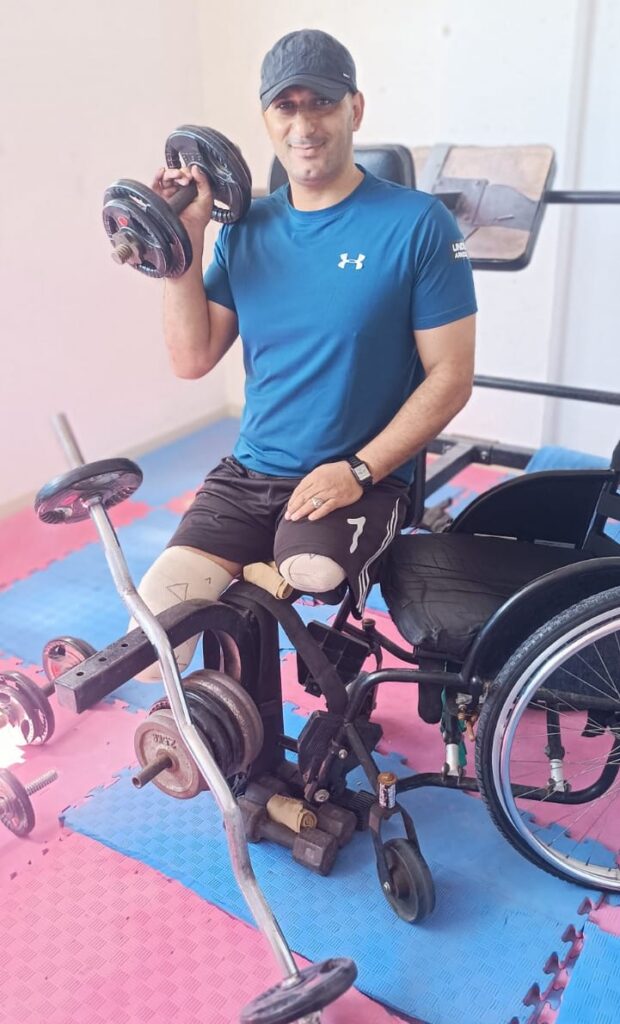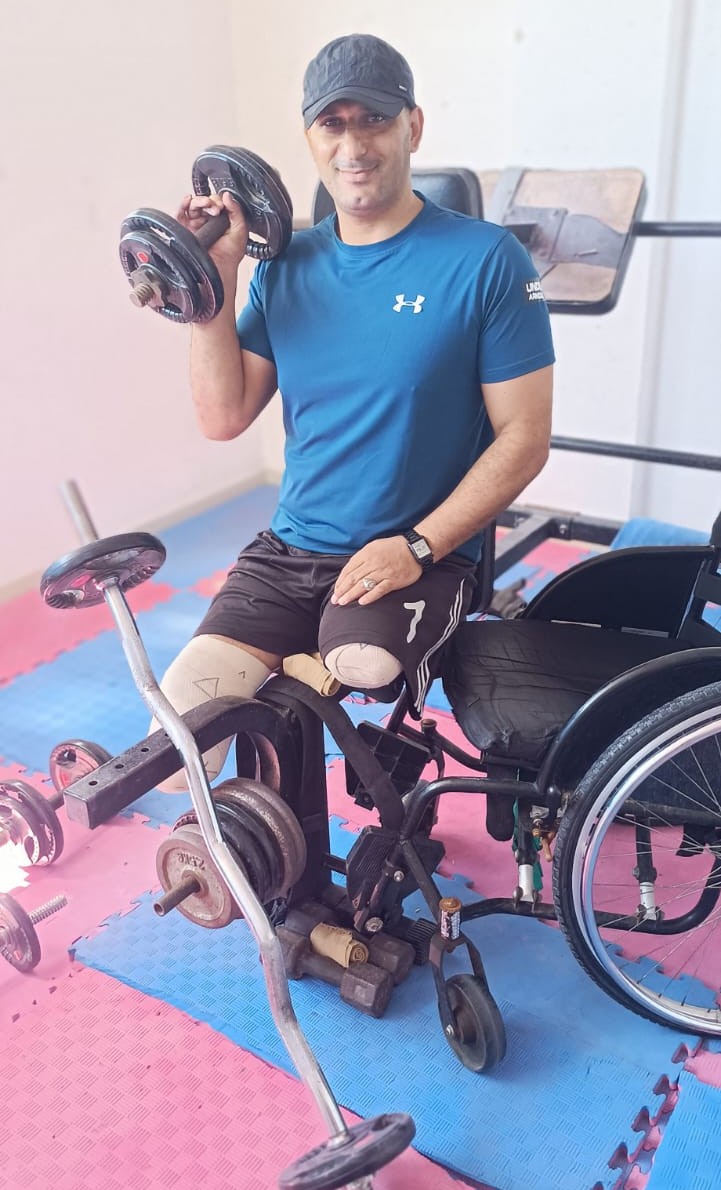
In a small room in his apartment in al-Shati’ refugee camp, northwest of Gaza City, Palestinian ‘Allam Mohammed Shubair (39) trains every day. Seated in his wheelchair, he repeatedly tries to lift his body, determined to regain his strength. Sports had been his whole life before an Israeli airstrike led to the amputation of both his legs. Now, he is working to prepare his body for prosthetic limbs once they become available.
Despite the immense pain he endures, a smile never leaves ‘Allam’s face as he speaks with PCHR’s field researcher. His features reflect a profound sense of contentment despite everything he has experienced during Israel’s ongoing genocidal campaign in the Gaza Strip.
‘Allam says: “There is no room for grief or despair. What has happened has happened, and regret will not bring anything back. I believe in God’s will and destiny, and I accept my condition with full contentment and patience.”
A Passion for Sports Since Childhood
‘Allam has a long and distinguished history in sports. He graduated from the Faculty of Physical Education at al-Aqsa University and is currently pursuing a master’s degree while working at the Ministry of Youth and Sports. He previously played football for al-Sadaqah and al-Shati’ Refugee Camp Sports Clubs. He also worked as a swimming coach and used to cycle daily with a his fellow athletes, riding from Gaza Seaport all the way to Rafah.
‘Allam recalls those days, saying: “I have been passionate about sports since childhood. Football was my first love, and I grew up playing it in the narrow alleys of the camp.”
He was also an active sports advocate who encouraged young people in the camp to strengthen both their bodies and minds, firmly believing in the saying “a healthy mind lives in a healthy body.”
Before Israel’s military offensive on the Gaza Strip began in October 2023, ‘Allam was putting the finishing touches on what he envisioned as his life’s work: a comprehensive sports club for men and women that would promote physical fitness, health, and community awareness. Reflecting on the project, he says: “I saw it as something meaningful I could offer to my people in the camp.”
War Turns His Life Upside Down and Takes His Mother
A few days after the genocidal war began, ‘Allam’s family evacuated to the southern Gaza Strip because of his mother’s critical health condition. She suffered from kidney failure and required regular dialysis sessions. ‘Allam, however, decided to remain in Gaza City, moving between al-Shifa and al-Ahli al-Arabi (Baptist) Hospitals and returning to his home in al-Shati’ refugee camp. There, he tried to maintain his fitness through simple exercises in his room. He recalls: “I tried to maintain my well-being and hold on to a part of the life I used to have, despite the destruction and fear surrounding me.”
He still vividly recalls the first days of the starvation that he endured alone. Describing that period, he says: “Those were the hardest days. I searched for anything that could stave off my hunger, but it was not easy at all.”
In December 2023, ‘Allam received news of his mother’s death in the southern Gaza Strip, after dialysis machines had stopped functioning amid the collapse of the healthcare system. He recalls: “She passed away without my being able to say goodbye to her. Her absence has left a wound in my heart that will never heal.”
Despite the ongoing displacement, starvation, intense bombardment, and repeated airstrikes, ‘Allam continued to encourage young people in the camp to engage in sports and to spread hope among them.
The Moment of the Attack
In 2025, the food crisis deepened once again as IOF military vehicles advanced amid heavy bombardment. The IOF once again ordered residents of Gaza City and the northern Gaza Strip to move south. ‘Allam’s father relocated to Deir al-Balah, where he rented a plot of land and set up tents for the family. He urged ‘Allam to join them. ‘Allam recalls: “I told him I would just move some of my belongings to a friend’s house and then join them.”
On 20 September 2025, the day he decided to evacuate to the south, ‘Allam went to al-Samer Intersection in central Gaza City to meet a friend. While there, he was caught in an Israeli attack. He bitterly recalls what happened: “I lost consciousness. When I woke up, I found myself in al-Ahli al-‘Arabi (Baptist) Hospital, where I was confronted with the harsh truth: I had lost both my legs, and my right hand had sustained a permanent injury that would prevent me from closing my palm.”
‘Allam was not the only athlete targeted by IOF’s fire during the genocidal campaign in the Gaza Strip. Over the past three years, attacks by the IOF have killed 1,014 athletes and injured hundreds more, some of whom sustained amputations or permanent disabilities. The attacks have also destroyed 286 sports facilities, including the headquarters of the Higher Council for Youth and Sports, the Palestinian Olympic Committee, and the Palestinian Football Association, as well as numerous clubs, academies, and sports federations, according to the Palestinian Olympic Committee and the Palestinian Sports Media Federation.
From Treatment to Rehabilitation
‘Allam spent two months at the Belgian field hospital in al-Zawayda, in the central Gaza Strip, where he received medical care, rehabilitation, and physiotherapy. He was also provided with a wheelchair to help him get around. He recalls: “Those were very difficult days, but I, who had built my life upon the belief that a strong body is shaped by determination, refused to surrender to my new reality.”
A Dream That Never Dies
Despite everything he has endured, ‘Allam continues to pursue his dreams. He has turned one of the rooms in his apartment into a small training space, where he exercises daily to maintain his muscle mass and strengthen his body. He explains: “My goal is clear: I want to prepare my body to bear the weight of prosthetic limbs, if they become available, so that I can return to an active life and regain as much mobility as possible.”
The dangers in Gaza remain immense, with each passing day bringing further bombardment and airstrikes, while access to medical treatment remains severely limited. Yet ‘Allam has not abandoned his dream of establishing a large sports club; it remains firmly part of his plans.