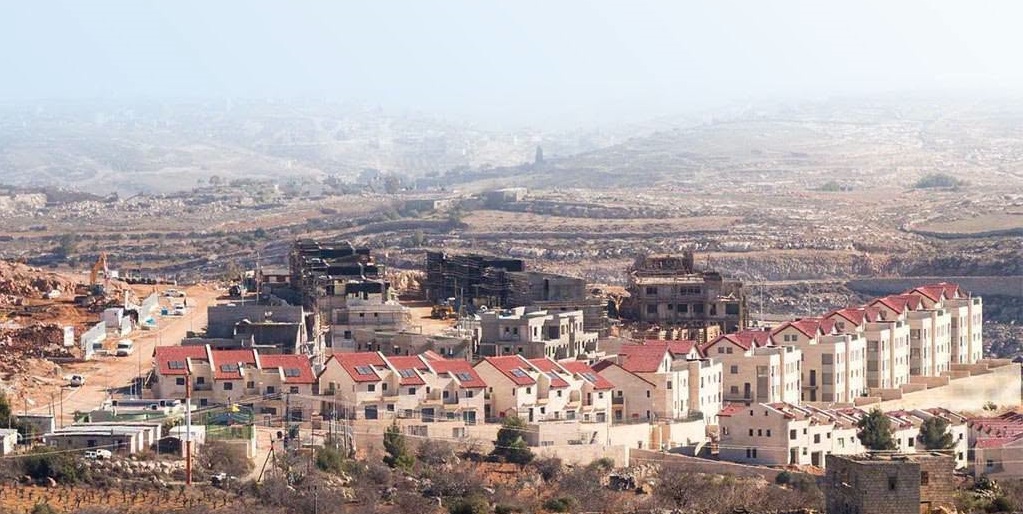
The Palestinian Centre for Human Rights (PCHR) condemns in the strongest terms the Israeli occupation authorities’ escalation of measures to implement the E1 settlement project in the eastern part of occupied Jerusalem. Most recently, the authorities opened up a tender for the construction of 1,234 settlement units, marking a serious qualitative shift in the project’s trajectory, from the planning and approval stage to the actual marketing of land and practical implementation, thereby entrenching a settlement reality on the ground.
This comes amid accelerating settlement expansion and the imposition of facts on the ground, as part of a plan in which settlers serve as an advanced arm of the occupation in a systematic and ongoing campaign of ethnic cleansing aimed at eradicating the Palestinian presence in the West Bank, including occupied Jerusalem.
The Israeli Ministry of Construction and Housing opened up a tender on 18 August 2026 for the construction of 1,234 settlement units in the E1 area, out of the 3,401 units for which plans had already been approved.1 The Ministry set 19 October 2026 as the deadline for submitting bids, just eight days before Israel’s 27 October elections, raising concerns that the settlement project is being used as a tool in Israel’s electoral competition by presenting it as a political and settlement achievement at the expense of the rights of the Palestinian people and the reality on the ground. This reflects the continued use of settlement expansion as a tool to impose facts on the ground and secure domestic political gains. Meanwhile, the Israeli authorities continue measures to establish an employment and commercial zone in the area, further strengthening the settlement’s connection with “Ma’ale Adumim” settlement in occupied Jerusalem and entrenching new settlement facts on the ground.
The E1 area extends across a vast and strategically important geographic zone stretching from the villages of al-‘Izariyah and Abu Dis in eastern Jerusalem to the outskirts of Jericho and the Dead Sea. According to information obtained by PCHR, 18 Palestinian communities comprising approximately 3,500 Palestinian residents are at risk of forced displacement from their lands as part of the project in East Jerusalem. These communities are among approximately 46 Bedouin communities currently at risk of forced displacement once the plan is fully implemented. Moreover, the Israeli authorities have already carried out forced displacement operations affecting some of these communities since 7 October 2023, as part of a systematic policy whose roots extend back to the displacement of Palestinian Bedouin communities in 1948 and 1967.
PCHR emphasizes that the E1 project is one of the most dangerous Israeli settlement projects in the occupied West Bank, given its potential to further fragment Palestinian territory, sever the northern West Bank from its south, and isolate East Jerusalem from its Palestinian surroundings. This undermines the Palestinian people’s right to self-determination and the possibility of establishing a contiguous and viable Palestinian state, a goal explicitly expressed by Israeli Finance Minister Bezalel Smotrich as part of the project’s objectives.
PCHR emphasizes that this shift to the land marketing stage, alongside the issuance of a separate tender to establish an operational and commercial zone within the same project, reveals the Israeli government’s intention to proceed with the implementation of the plan despite decades of repeated international condemnation.
PCHR believes that proceeding with the implementation of the project, alongside land confiscation, settlement expansion, and the imposition of restrictions on Palestinian communities in the area, forms part of a systematic Israeli policy aimed at asserting permanent sovereignty over the occupied territory and creating the conditions for the forcible transfer of the Palestinian population, particularly Bedouin communities in the vicinity of E1.
PCHR warns that the international community’s continued reliance on condemnation without taking practical measures emboldens the Israeli authorities to proceed with the implementation of the project and impose irreversible facts on the ground. PCHR calls on the States Parties to the Fourth Geneva Convention to fulfill their obligations to ensure respect for the Convention and take effective measures to halt settlement activity and end the forced displacement of the Palestinian population.
PCHR emphasizes that Israeli settlement activity in the occupied Palestinian territory, including East Jerusalem, constitutes a continuing violation of international law and United Nations resolutions. PCHR further stresses that the E1 project cannot be viewed in isolation from a broader policy aimed at entrenching the de facto annexation of the West Bank and imposing a permanent regime of sovereignty over the Palestinian land and population.
PCHR recalls that Israeli settlement activity, including the E1 project, constitutes a flagrant violation of Article 49 of the Fourth Geneva Convention, which prohibits an occupying Power from transferring parts of its own civilian population into the territory it occupies. PCHR furthers that The International Court of Justice (ICJ) affirmed in its July 2024 Advisory Opinion that Israel’s continued occupation of the Palestinian territory occupied since 1967 is unlawful and that Israel is under an obligation to end its unlawful presence, including by dismantling the settlements and evacuating the settlers. The Court further affirmed that third States have an obligation not to render aid or assistance in maintaining this unlawful situation.
It should be noted that the settlement file was among the first files to be discussed and determined before the International Criminal Court (ICC), which considers settlement activity a standalone war crime. PCHR had previously submitted, jointly with Al Mezan Centre for Human Rights and Al-Haq, a comprehensive legal submission to the Court documenting this crime and its constituent elements. The three organizations had also submitted a separate legal submission addressing the crime of apartheid, describing it as a crime arising from the settlement policy in the West Bank, including occupied East Jerusalem, and the consequent discriminatory, institutionalized, and repressive regime imposed on the Palestinian population.
PCHR stresses that the crime of settlement is a continuing crime by its very legal nature and is not subject to statutes of limitations, regardless of whether a long or short period of time had passed. Accordingly, those responsible for this crime must be held accountable at any time. This crime is also among the most extensively and officially documented Israeli crimes, as its details are publicly announced by Israeli ministries, ministers, and the government, as well as by the military, political party leaders, and settlers themselves. It is also officially published in the Israeli Official Gazette, making it a crime whose details are publicly and officially declared and documented and therefore do not require additional evidence to establish its occurrence. Israeli judicial authorities are involved in giving it a legal character through their rulings and decisions. Open-source information also functions as an important source of evidence for documenting this crime.
PCHR calls on the international community, particularly the United Nations, the Security Council, and the European Union, to take urgent and tangible measures to compel Israel to halt the E1 project and all settlement activities in the occupied Palestinian territory, hold those responsible for its implementation accountable, and ensure that companies and organizations do not benefit from or participate in the implementation of illegal settlement projects.
PCHR urges United Nations Member States, particularly those that have issued positions opposing the project, to translate these positions into binding measures, including prohibiting their companies and economic entities from engaging in any tender or activity related to settlements in the occupied Palestinian territory, in fulfillment of their obligations under the International Court of Justice Advisory Opinion.
PCHR calls upon the Swiss Government, as the depositary state of the Fourth Geneva Convention, to assume its pivotal role in confronting settlement activity by convening a conference of the High Contracting Parties to the Convention to discuss ways to confront and halt settlement activity and to adopt all necessary measures and impose effective penalties against the occupying Power in order to ensure respect for its obligations under the Convention.