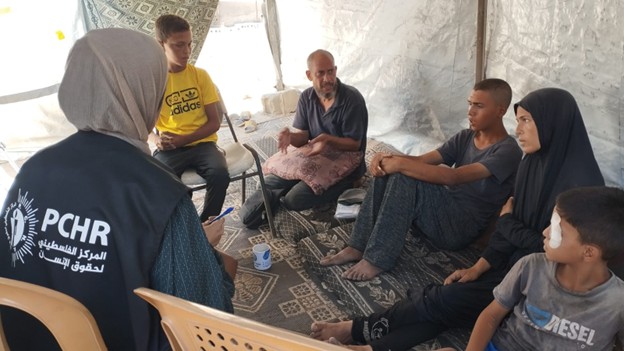
Date of Testimony: 4 August 2025
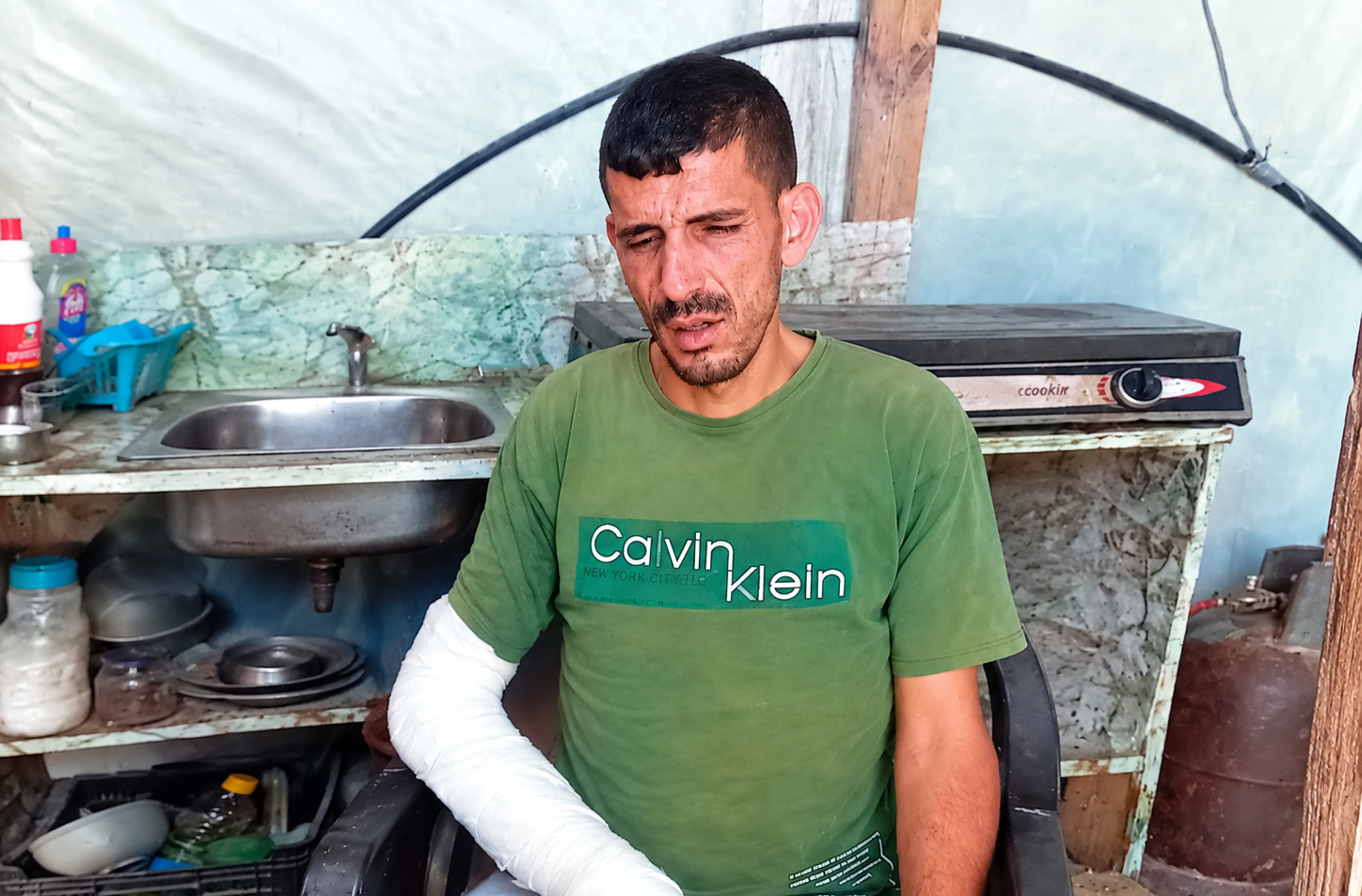
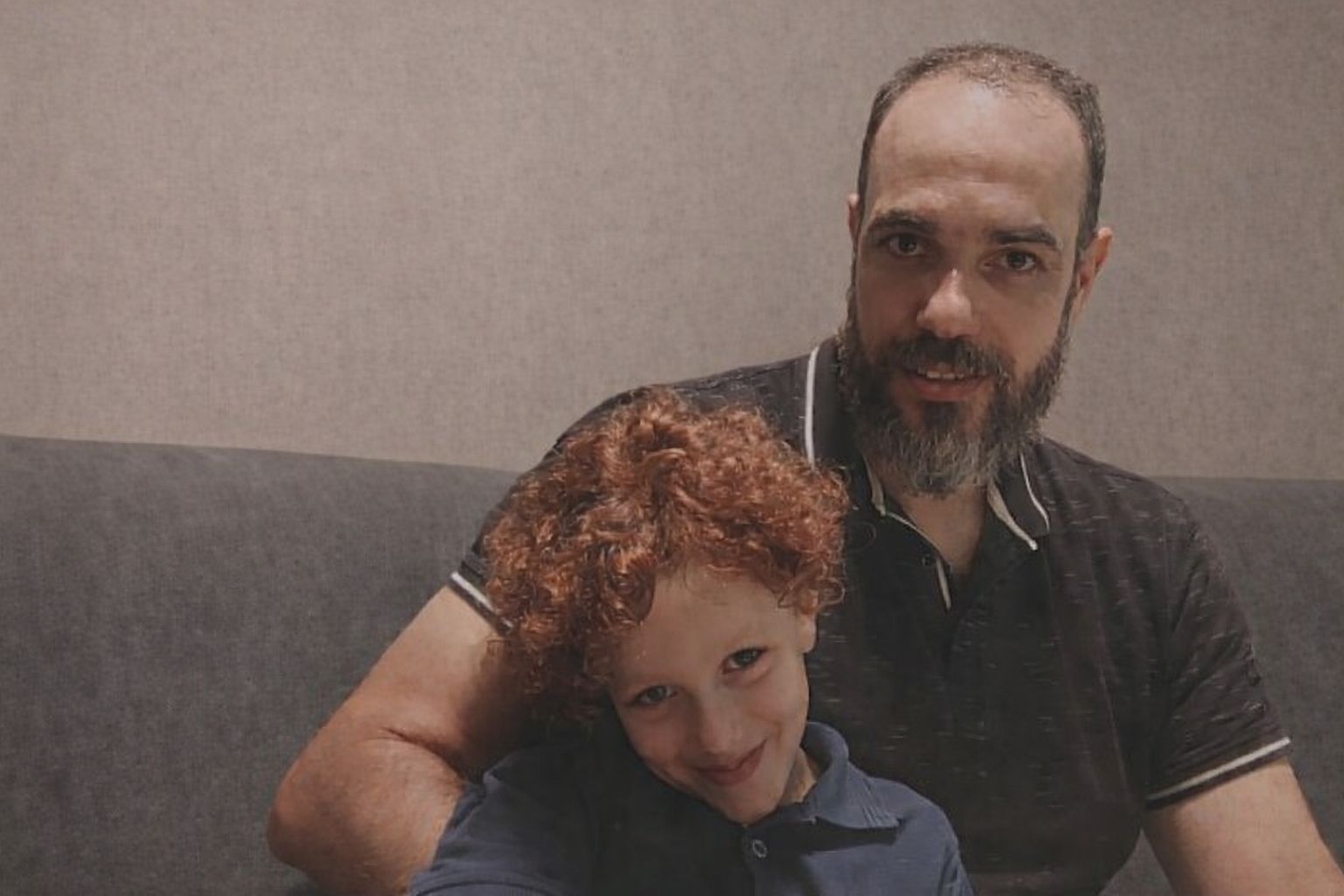
My name is A’ed Ibrahim Mohammad Abu Khater, 48 years old, and my wife is Sa’ida Yehya Ahmed Abu Khater, 45 years old.
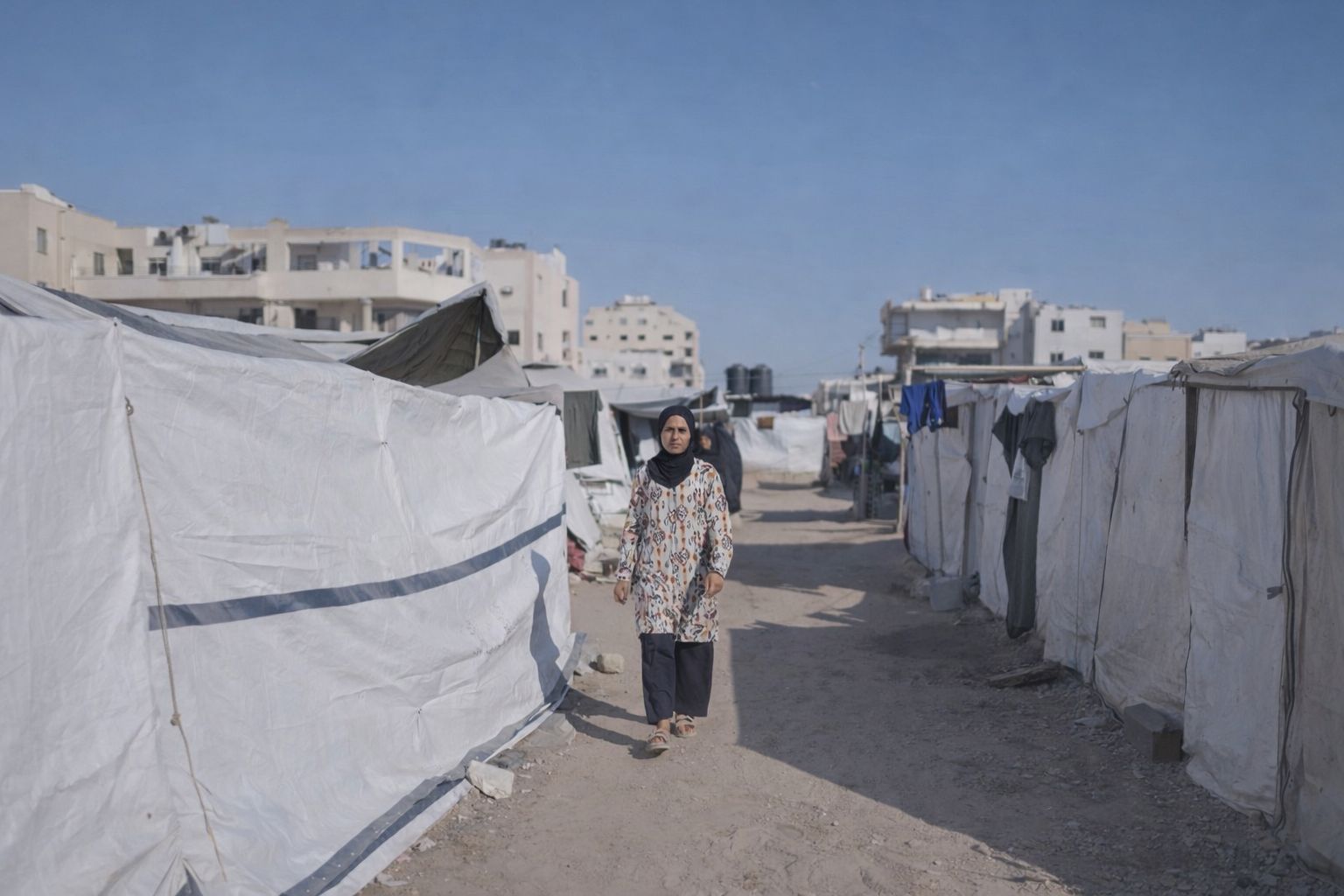
We are a Palestinian family from Beit Lahiya Project in the northern Gaza Strip. We lived in a small apartment gifted to me by my late father, as he had done with all ten of my siblings, to help each of us start a life of our own. Our life was modest but dignified, marked by family warmth and contentment. Today, we live in a tent across from the maternity building at Al-Shifa Hospital.
My wife and I had six children: Ibrahim (23), Ne’ma (21), Atef (18), Mohammad (15), Yehya (11), and Ziad (8). As I give this testimony, we have lost two of them—Ziad and Atef—each taken in a tragic way, in a war that has stripped us of every sense of safety.
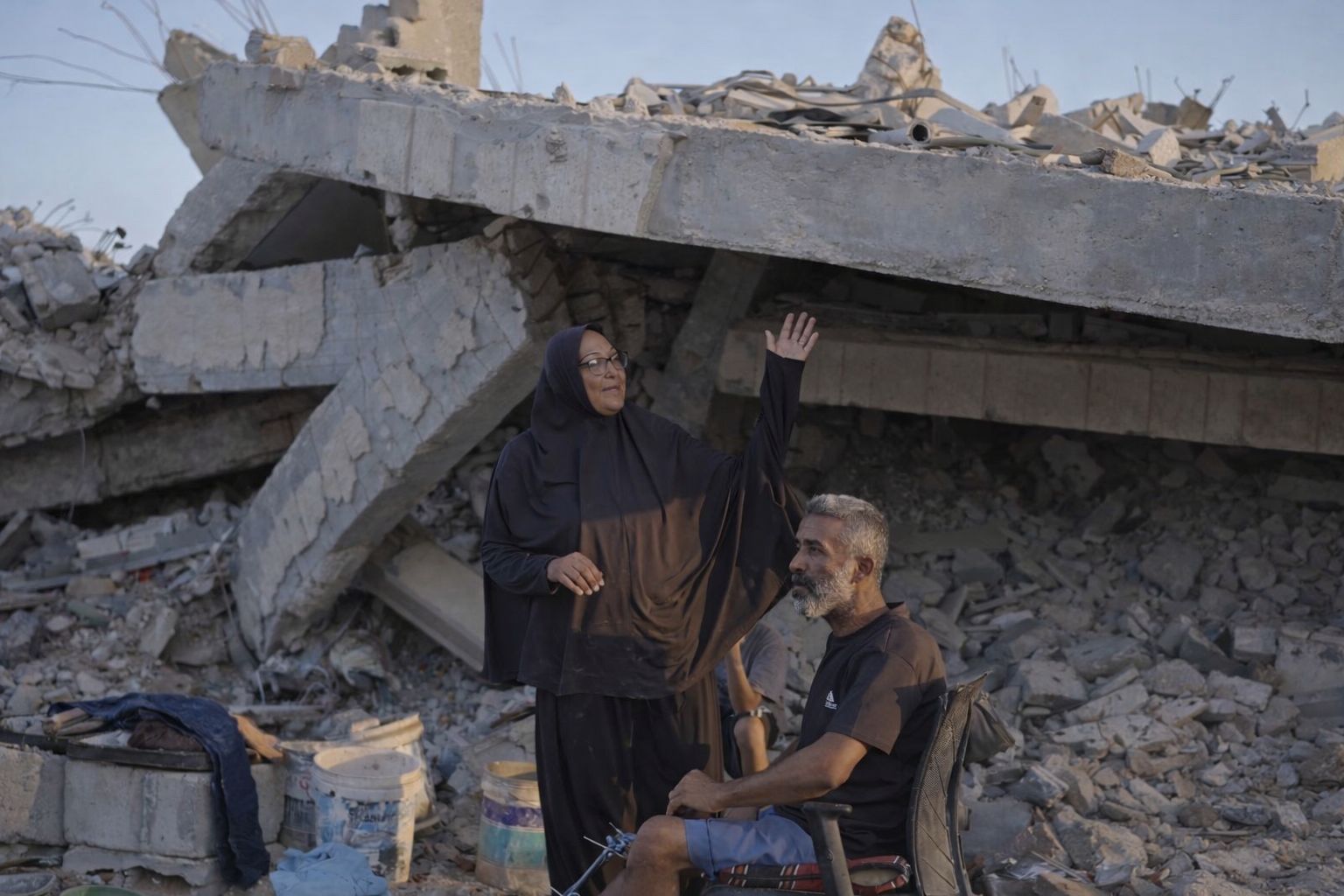
With the outbreak of the genocide on 7 October 2023, our area became a hell on earth, given its proximity to the border and the surrounding farmland that became direct targets of bombardment. Explosions never ceased, and fear never left us. Just a week into the war, a house next to ours was bombed, forcing us to flee, leaving everything behind. Even my daughter Ne’ma’s small project for making cosmetics and soap, into which she had invested more than 4,000 dinars, remained abandoned in the house with all its materials and plans. We left with nothing but the clothes we wore, not knowing how we had survived.
We first fled to Jabalia Camp, then to the south, taking shelter in Al-Riyadh School in Al-Nuseirat, where we stayed until January 2024, sharing one classroom with three other families in harsh conditions. To provide for us, my sons Mohammad and Atef began selling custard inside the school. We tried to live with dignity without asking for help.
When orders came to evacuate the school due to the Israeli military operations in Al-Bureij, everyone left, and we were left facing the unknown. I remember one day, while still living in the school, direct gunfire was suddenly aimed at the Palestinian flag in the schoolyard, with Israeli forces stationed directly opposite. I turned to my wife and said, “This is a sign. We must leave.”
We moved to Tel Al-Sultan in Rafah, where we stayed until May 2024, then were displaced again to the Al-Iqlimy area between Rafah and Khan Younis. We lived there for 20 days of torment. The hardest task was fetching water—my sons would leave at 5:00 a.m. and return by late afternoon with only a few gallons. Life then was a battle for survival.
One morning, I told my children, “We need to leave this place. I don’t feel safe here.” I contacted a driver friend to help us reach Deir Al-Balah.
But on the morning of 23 June 2024, my wife and daughter Ne’ma left for Deir Al-Balah to meet her teacher and collect the materials for their cosmetics project. I agreed on the condition that they take Ziad with them, but he came to me and said, “I want to stay with you. Mama will bring me things.” Ibrahim went to the market, and Mohammad and Atef went out to sell lupini beans. I was standing in front of the tent when suddenly a massive explosion struck the water barrels across from us. I felt blood pouring from my head, my hands, and my feet pierced with shrapnel.
At that moment, Ziad was eating with Yehya. A shrapnel struck his head directly, and he was killed instantly.
I was taken to the British Field Hospital, where I fell into a coma due to my injuries. When I awoke, my first thought was for my son Yehya, because he was close to the site of the explosion. I didn’t know my children were in the tent, nor did it ever cross my mind that Ziad had been hit; I thought he was playing at his cousins’ home.
Minutes before the bombing, Ziad had brought some maftoul (couscous) and called his brother to eat with him, leaving his work aside. When I asked my brother about Yehya, he said he was fine—but his voice carried a sorrow he couldn’t hide. Later, when my father, Ibrahim, and my nephews visited me in the hospital, I was told I needed urgent surgery. But I refused until I knew what had happened to my children. From their faces, I sensed I had lost one.
I asked again, “Where is Yehya?” They said he was hit with two pieces of shrapnel in his shoulder but had been discharged. Still, I was uneasy. I refused to enter the operating room, insisting: “I will not undergo surgery until you tell me which of my children is gone.” My son Ibrahim broke into tears, and finally someone said: “May God have mercy on him.”
Shocked, I asked, “Who?!” They said: “Ziad.”
I didn’t even know he had been in the tent when it was hit. His uncles buried him. I never said goodbye, never gave him a last look, never held him one last time.
Ziad was no ordinary child to me. All my children are dear to me, but he was the closest. Born after my retirement, he was my constant companion. My friends called him “my bag” because he never left my side. Every Eid prayer, we went together. He filled my life with laughter and light-heartedness. He was bright, eloquent, beloved by all, and people enjoyed listening to him speak. Now he is gone—without farewell, without a final look, without even one last moment.
After Ziad’s death, my wife and children stayed with my brothers in the Asda’ area. Mohammad and Atef continued selling lupini beans to support us. Their mother could not sleep, sitting on a sand dune waiting for them to return in an area deserted and frightening, full of stray dogs. During my time in the hospital, I sent them whatever food I was given. Their mother would stand in line for hours at the bakery, trying to bring back one bag of bread. That was all we lived on.
After I underwent a bone graft operation, I remained in hospital for a long period. Just three days before Ramadan, in late February 2025, my wife and children had to return to the north with no shelter after our home was destroyed. They stayed with acquaintances for a week, then searched desperately for a tent, applying to institutions and aid groups, but in vain. They spent their days in the street, trying to find shelter, unable to transport the few sheets and wood we had, having walked all the way back from the south on foot—without me due to my injury, and without any transportation.
Eventually, she managed to obtain a tent and set it up at Khalifa Bin Zayed School in Beit Lahiya. But they were later forced to leave, moving to the Al-Amn Al-A’am [public security] area, then to Al-Shifa. They lived there for a week without sleep, plagued by cold, fear, insects, and rats. The suffering never ended. They then moved again to the chalets area by the sea, where humidity and cold worsened their ordeal. My daughter Ne’ma developed an eye infection, and for three days they had nothing to eat, going to sleep hungry and waking even weaker. Among them was Atef, whose body was breaking down from hunger and exhaustion.
One Friday in late June 2025, we received a voucher for a meal from a charity kitchen. My wife sent Atef to collect it. She watched him run with the pot as though hunger had stolen his senses, so much so that his sister ran after him out of fear for him. He returned with a small portion of lentils, but some spilled on him and burned his foot. He didn’t feel the pain—hunger was stronger than any wound.
That night, they all shared what he brought: just two spoons each, barely enough to keep them alive. Days later, Atef’s toe swelled. His brother Ibrahim took him to hospital, but his condition quickly deteriorated. Within three days, he could no longer stand and lost his sense of hunger entirely. Even bitter tea and scraps of bread were forced into him. His body weakened, he lost the ability to walk, and he needed help even to relieve himself.
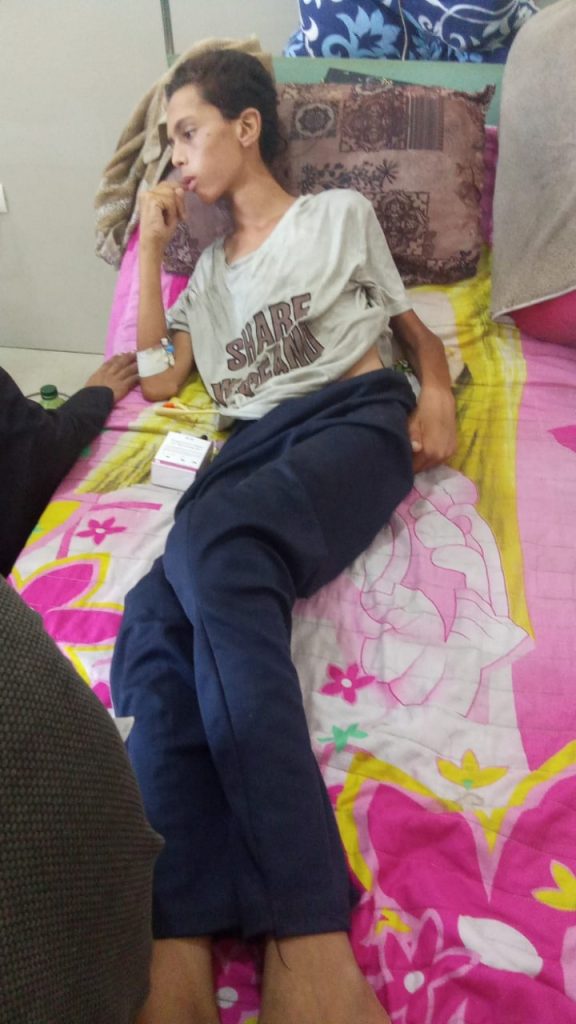
When I was finally discharged from hospital and saw him, I didn’t recognize him. I asked his mother: “Who is this? What happened to him?” His body was skeletal, barely moving, his voice faint. I rushed him to the hospital. The doctors were shocked at his state.
We went from one hospital to another—Al-Shifa, Al-Ma’madani, Al-Rantisi—undergoing tests, scans, biopsies. Every result came back “normal,” yet no one explained his weight loss, his paralysis, or his slurred speech. Eventually, they diagnosed him with “severe trauma compounded by acute malnutrition.”
He spent 18 days in Al-Helou Hospital surviving only on IV fluids. He refused or was unable to eat. Even water had to be injected into his body by syringe. Malnutrition caused muscular atrophy and paralysis; he lost the ability to chew. Bedsores spread across his back. His body was nothing but skin and bone.
Doctors disagreed: some discharged him, others insisted he be transferred abroad. We left without a solution. I consulted a doctor who knew his case; he sent us to Dr. Abdullah Al-Jammal at Al-Daraj Clinic. The moment he saw him, he said: “This boy is dying. This is not psychological trauma; this is acute malnutrition. He must be transferred abroad immediately.”
But Atef needed expensive care—diapers, nutritional supplements—beyond my ability to provide. I spent nights awake by his side, listening to his groans and cries of pain.
On Friday night, 1 August 2025, I received a call about transferring him abroad for treatment. They asked me to prepare the papers and admit him to the hospital the next morning. But on the morning of 2 August, while his mother and siblings were preparing him for transfer, I suddenly heard them cry out: “Abu Ibrahim, come quickly! Something is wrong with Atef!” I ran in. I looked at him and said: “Atef is gone. God have mercy on him.”
Atef died—just as Ziad had before him. Starving, oppressed, denied even the chance to live.
Atef had been strong-willed, beloved by everyone, preparing to take his high school exams before the war stole that from him. He died of hunger and malnutrition in the midst of a brutal war, with no chance of timely rescue. He was not sick before the war; it was siege, hunger, cold, and bombardment that killed him.
Today we live in a tent near Al-Shifa Hospital—without a real home, without safety—carrying our grief, telling our story, hoping the world will listen.
This is not just my family’s story. It is the story of every Palestinian family that has lost children amid genocide and the silence of the world.