Date of Testimony: 5 August 2025
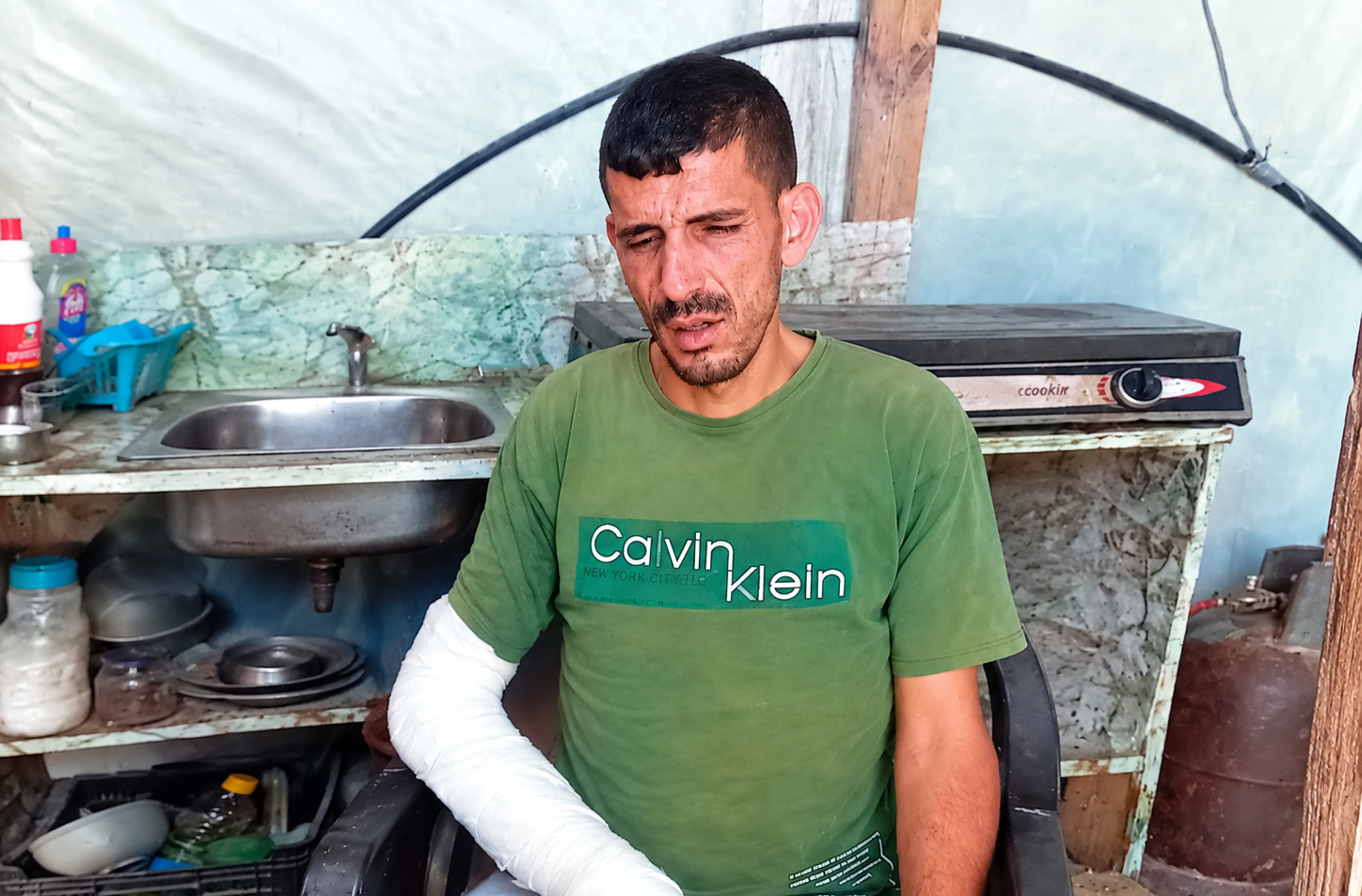
Ahmed Mousa Shehada Eliyan, 46 years old, married, resident of Juhor al-Deek in southern Gaza, currently forcibly displaced in Al-Mawasi, Khan Younis.
I am married to Noor Fouad Ahmed Al-Dahshan, 35 years old, and we have five children (four boys and one girl). We used to live in a 115 m² apartment on the fifth floor of the Kuwaiti Towers in Wadi Gaza village, south of Gaza (Juhor al-Deek). I work as a freelance journalist.
At around 8:00 a.m. on Saturday, 7 October 2023, at the start of the Israeli offensive on Gaza, I fled to my family’s home in the Al-Sahaba area of Gaza City. My wife, Noor, was in the early stages of pregnancy at the time. We stayed with my family for six months, but the situation in Gaza became extremely difficult, with famine spreading rapidly. I decided to evacuate with my family via Al-Rashid Street towards the south. On the way, I was arrested by Israeli soldiers stationed around Al-Baydar Hall, while my wife and children were allowed to continue south.
12 Hours of Detention
Upon arrest, the soldiers ordered me to strip down to my underwear, handcuffed my hands behind my back with plastic ties, and blindfolded me with a piece of cloth. They took me to Al-Baydar Hall, where I was detained for about 12 hours, from 8:00 a.m. to 8:00 p.m. During that time, I was interrogated, tortured, and threatened with death.
They asked me: Where were you on 7 October? Where are the tunnels? Where do you work? Where is the resistance? During the interrogation, I was beaten with punches, kicks, and slaps; dragged down a staircase from the second floor to the ground; and forced to walk on barbed wire, which caused bleeding from my feet.
They also threatened to imprison me for 20 years in the Negev Prison and to execute me. One soldier pressed his weapon against the back of my head while my hands were tied, forcing me to kneel with my head down, causing me to faint. Another soldier poured water on me until I regained consciousness. He asked if I spoke Hebrew; when I replied no, he spoke to the soldiers in Hebrew, then told me to get dressed and said I would be released. They freed me, and I headed south, not knowing where to go. Along the way, I met someone and asked to use his phone to contact my wife, who was with the Red Cross in Al-Nuseirat. I later reached Rafah, where we stayed for three months.
When the Israeli ground operation in Rafah began in early May 2024, we fled to Al-Shafi’i camp in Al-Mawasi, Khan Younis, where we remain to this day. My wife gave birth to our daughter, Misk, in Khan Younis on 30 May 2024.
The Bombing of the Tents
At around 10:44 p.m. on Saturday, 27 April 2025, while my wife, children, and I were sleeping in our tent, I awoke to the sound of an explosion and screaming outside. I told my wife, “They bombed inside our camp.” I called out to her several times, but she did not respond. I heard my baby daughter, Misk, crying briefly before falling silent. She had been in her mother’s arms.
At that moment, my 13-year-old son, Nasr, turned on the phone flashlight. I opened the tent and saw flames engulfing a tent about 20–30 meters to the west of ours. When I turned the light toward my wife, I saw the head of my 11-month-old daughter, Misk, covered in blood, and heard my wife making a choking sound as she bled from her head. I told my children, “Your mother has been martyred,” but when I placed my hand on her neck, I felt a faint pulse. I initially thought the blood on Misk’s head was from my wife’s injury, and I screamed for help.
Young men arrived and took my daughter to an ambulance that had just reached the site. We then rushed my wife to the Kuwaiti Field Hospital, about 500 meters to the west. She was later transferred to Nasser Medical Complex and placed in the intensive care unit. Shortly afterward, they brought my daughter, Misk, to me, and I was informed of her death at around midnight on Sunday, 28 April 2025.
The following morning, after completing the necessary procedures, I buried my daughter Misk in the Al-Joura Cemetery behind Al-Namsawi area in southwest Khan Younis. My wife remained in intensive care, suffering from a fractured skull and severe nerve damage, which left her unable to speak or comprehend.
A few days later, she was discharged from Nasser Medical Complex, still requiring treatment abroad. Since then, my 12-year-old daughter, Malak, has taken over household responsibilities such as cooking, cleaning, and laundry, as her mother sometimes recognizes us and sometimes does not.
I later learned that the bombing was carried out by an Israeli helicopter targeting a tent. According to my knowledge, a man and his wife were killed, along with another forcibly displaced woman, their neighbour in the tents, Maram Jaber Madi, 28 years old. Others were wounded with varying degrees of injury.