Testimony Date: 28 June 2025
My name is Ghadeer Jawad Asaad Abu Al-Eish. I am 39 years old, from Sheikh Ajleen in Gaza. I’m married to Yousef Mohammad Abu Al-Eish, and we have five children: Hiyam (19), the martyr Mohammad (16), the martyr Ramzi (14), Yasser (16), and Yazan (14).
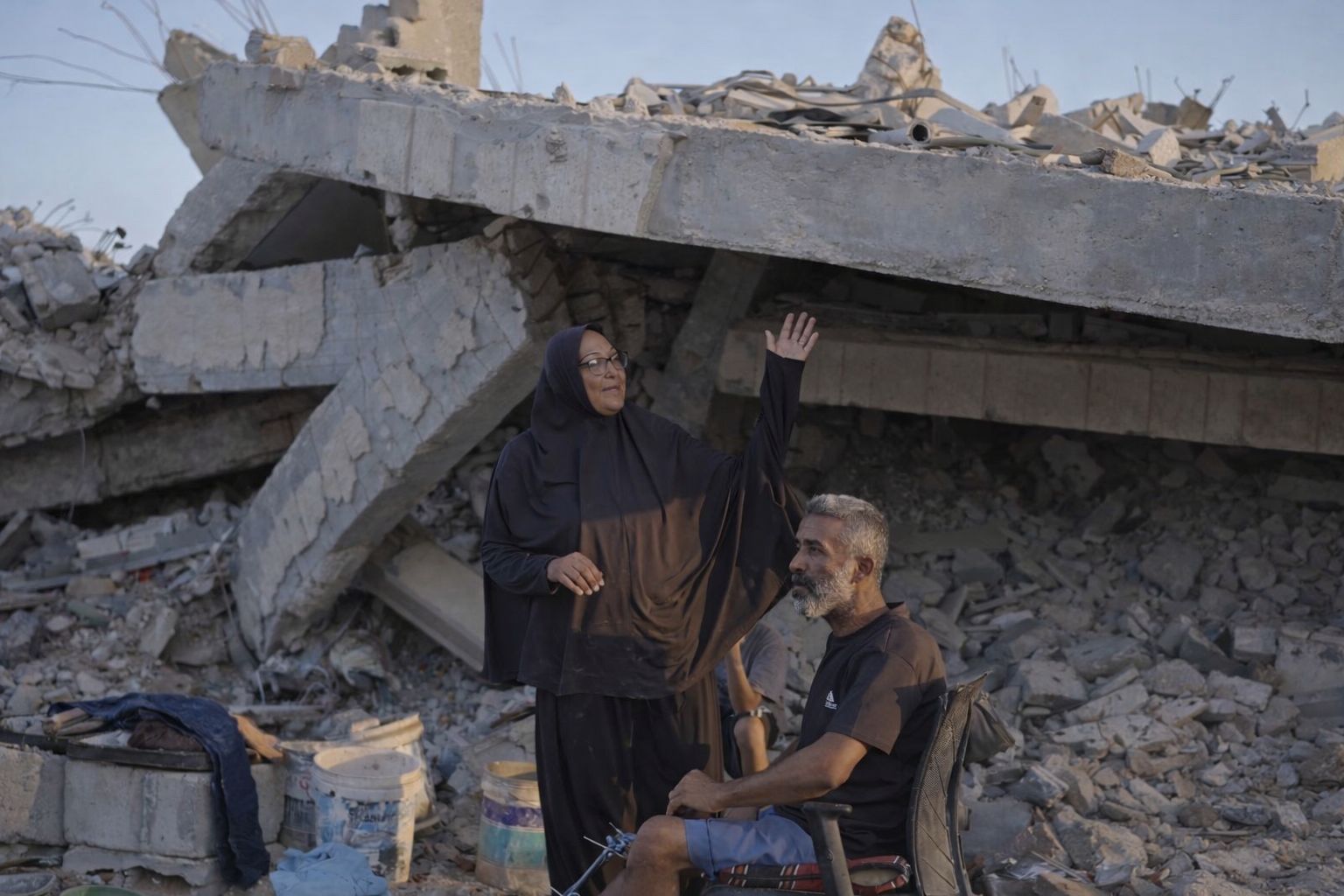
Since the war began on 7 October 2023, we had been staying in our home in Sheikh Ajleen. On the afternoon of 30 October, Israeli warplanes bombed the upper floors of our building, targeting our home and those of our neighbours. We received threatening messages ordering us to evacuate and head south. Everyone around us left, but we stayed behind. Eventually, we moved to my sister-in-law’s home in Sheikh Radwan.
The next morning, I took the children to Al-Quds Hospital. My husband Yousef and our son Yasser stayed behind. My two sons, Mohammad and Ramzi, were on their way home when an Israeli airstrike targeted them near Sheikh Ajleen Mosque. My husband heard the explosion and immediately sensed something terrible had happened. He and Yasser rushed to the scene and found Mohammad and Ramzi killed—shrapnel had torn their bodies apart, and they were lying lifeless on the ground.
My husband called me at Al-Quds Hospital to deliver the news that shattered my heart. I ran with my son Yazan, desperately searching for a way to save them. I pleaded with the hospital to send ambulances. After much crying and begging, four ambulances were dispatched. I rode in the first one, clinging to a single hope—that my sons were still alive. The entire way there, I kept repeating, “Oh God, there is no power nor strength except through You,” praying they had survived.
When I arrived at the scene, a paramedic asked me to call my husband, but he didn’t answer. The ambulance driver said, “It looks like they’ve all been killed,” and my anxiety grew. Minutes later, my husband and son Yasser arrived. They had been waiting for the bodies to be retrieved. Only the ambulance I was in moved forward into the bombing site; the others stayed behind. A paramedic stepped out of one of the vehicles and began filming my sons’ bodies. I screamed at him in total collapse, falling to my knees from the horror of what I was witnessing.
I saw them carry Ramzi’s body in a bag soaked with blood. At that moment, I knew for certain he was gone. I had still been holding onto hope. I whispered, “There is no power nor strength except through God. I bear witness that there is no god but Allah.”
I asked the team to retrieve Mohammad’s body, but they refused because Israeli aircraft were still flying overhead, fearing another strike. I begged them, but they insisted on leaving.
I returned in the ambulance with Ramzi’s body, holding his hand and repeating, “There is no power nor strength except through God.” I felt a pulse in his hand, and his eyes were still open—like he was still alive. We arrived at Al-Shifa Hospital, and Ramzi was immediately placed in the morgue. After he was shrouded, I looked at my hands stained with his blood and sobbed to my husband: “I don’t want to wash them off. How can I sleep without my sons, Yousef?”
Later, I tried through the Red Cross to retrieve Mohammad’s body, but nothing worked due to the worsening security situation. No one could reach him. After 40 days, my son Yasser searched for his brother’s body, but found nothing. We eventually learned that many unidentified bodies had been buried five days after the bombing. To this day, I don’t know if Mohammad was among them.
All I want now is to find my child—even if only his bones—so I can bury him.
I lost my father when I was four years old, and his body was never found. I still have no grave to visit. I used to watch people visiting the graves of their loved ones and feel the sharp pain of deprivation. I thought I would one day forget that pain—but now it’s back, deeper than ever.
Two years after I married Yousef, we started a small project—a chalet near our home. It was our space of hope. But it, too, vanished along with everything else I lost: my home, my children, even my small dream. The hardest part is that I never got to bury Mohammad. My grief is doubled because his story is the same as my father’s—neither of them has a grave. All I have left are memories: Mohammad’s shirt, which I found in the rubble and washed for two days straight; his beloved horse sticks; and a bloodstained cloth from Ramzi that I still keep.
Now, I can’t sleep. I hear their voices everywhere. I see them every night in my dreams. My only wish is to find Mohammad, to bury him with my own hands, to give him a grave I can visit. I no longer want a home or money. All I want is a chance at a better life for the children I still have left.