Layali ‘Ali Isma’il al-Shenbari (20), a Married Woman from Beit Hanoun, Northern Gaza
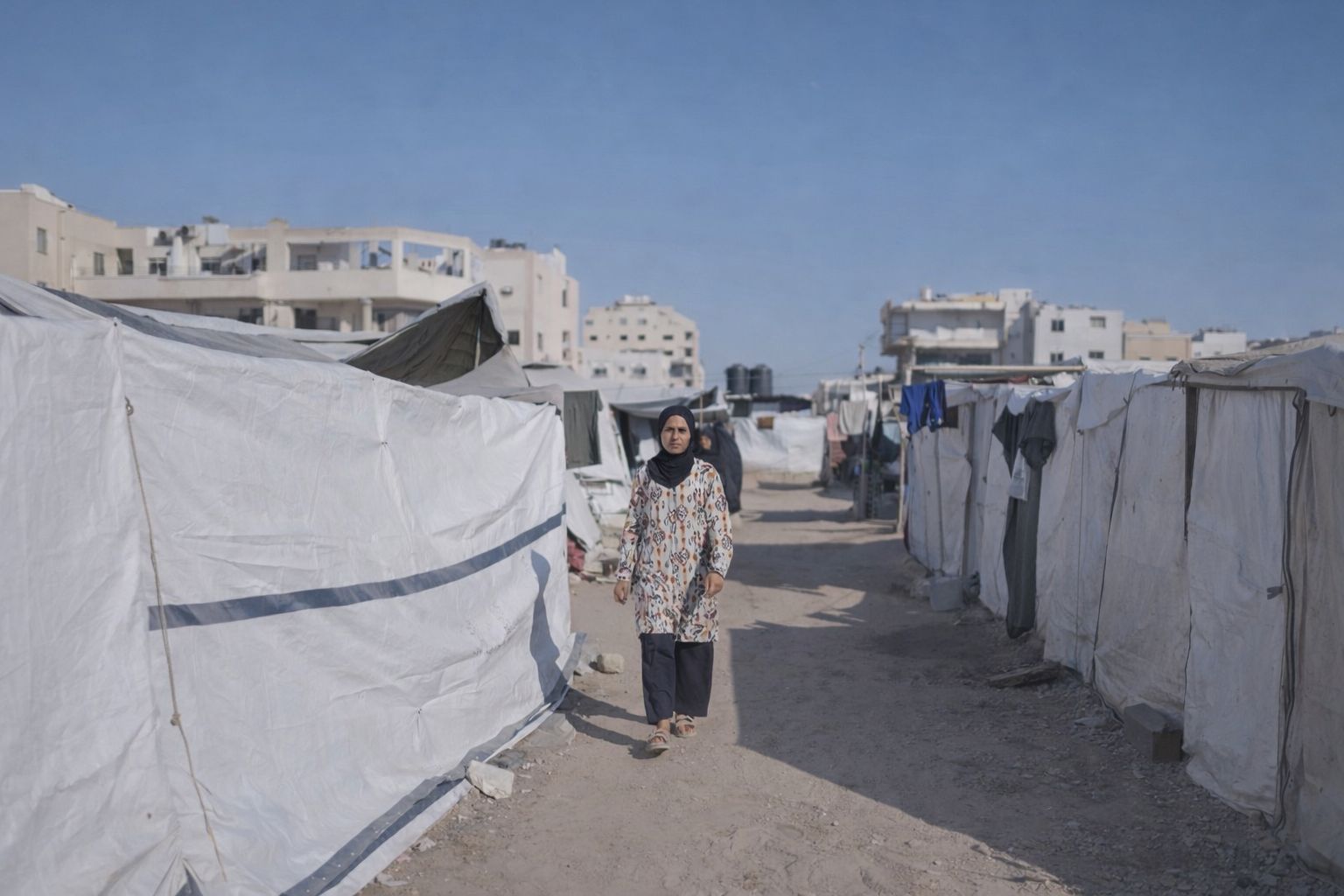
I live in Beit Hanoun, in the Boret Shurrab area. When the war broke out on 7 October 2023, I went to my family’s house on al-‘Ajami Street, which is not far from our home. Because of the heavy bombardment around me and the intense fear I felt, I could not take any of my clothes or even my identification papers with me. When I arrived at my family’s house, When I arrived at my family’s house, the IOF launched what is known as a “fire belt” across the area, forcing us to flee again, this time to Sheikh Zayed. My nephews and I got into the car, while the rest of my family walked until we reached Kuwait School. The schools were already overcrowded with displaced people, and we could not find a place for ourselves. We were therefore forced to set up a tarpaulin shelter to have somewhere to stay. Because we had fled so quickly, we could not take any of our mattresses or blankets with us. I had no choice but to sleep on the ground for two days, which caused me severe back pain.
Two days later, I moved to where my husband was staying with his family. They had rented a warehouse in Jabalia refugee camp. The warehouse was open, and we had no mattresses or blankets, so I had to sleep on the ground once again. At the time, I was five months pregnant and suffering from severe back pain and aches throughout my body. I used my bag as a pillow so that I could get some sleep.
At around 12:30 on 10 October 2023, the Temraz area of Jabalia refugee camp came under a fire belt by IOF ( successive and intense barrage of airstrikes.) As a result, four men were killed. Smoke filled the area, while shrapnel scattered everywhere. I saw the dead bodies flying through the air, with their torn remains scattered beneath my feet. I was terrified by what I saw. I could not bear the scene. I went into shock, and I began experiencing severe abdominal pain and contractions, leaving me unable to know what to do. Then, I suddenly felt a large amount of blood streaming from me.
On 11 October 2023, we fled again from the area where we had been staying, this time to Abu Zaytoun Schools in Jabalia refugee camp, along with my husband’s family. My abdominal pain continued, and the cramps became increasingly severe, accompanied by heavier bleeding. I was terrified for my fetus and afraid that something bad had happened to it. My mother-in-law tried to comfort me and calm me down, telling me that the pain was caused by fear and that nothing would happen to the baby.
I took “Dexamol” because I had no other medicine available at the time, so I simply had to adapt to the situation. Days passed, and I entered my sixth month of pregnancy. On 23 March 2024, my father-in-law was killed while trying to bring flour on Dolah Street. His death came as a shock to me and caused me severe pain that once again felt like contractions. At around midnight, I was taken by ambulance to al-‘Awda Hospital in northern Gaza, where the doctor advised me to get complete rest and avoid carrying anything heavy to protect the baby. At the time, I had been carrying water from the ground floor, from the schoolyard, up to the third floor of the school where I was staying with my husband’s family. I was also washing the clothes of all 16 members of my husband’s family. After I was discharged from the hospital, I went to stay with my family at Jabalia Elementary School for Boys (C), “Al-Ayoubiyah.” I lay on my back without moving. Thankfully, my condition improved.
As I approached the end of my eighth month of pregnancy, with only 10 days left before reaching nine months, I went to stay with my husband’s family at Jabalia Elementary School for Boys B-D. They had asked me to stay with them so they could be there for me as I prepared for the delivery, especially since this was the first baby in the family. On 17 January 2024, I began having labor contractions, so I went to Kamal ‘Edwan Hospital. Because there was no transportation available, I had to travel there on a donkey-drawn cart. The delivery was very difficult. I spent three days in the hospital, where I received injections and was given exercises to help ease the delivery. I gave birth to my baby on 20 January 2024 at around 17:30. I then remained in the hospital under observation because my blood levels were low and the doctors were concerned that I might suffer bleeding.
The day after I gave birth, on 21 January 2024, I noticed that my daughter had turned blue because the fluids had not been cleared from her body after birth. There were no functioning medical devices available due to the war. The doctors administered a nebulizer treatment to my baby, and we were able to leave the hospital on 22 January 2024.
We went to the school where my husband’s family was staying, Jabalia Elementary School for Boys B-D. However, the classroom was crammed with three families, leaving no privacy. I could barely get any rest and could not even lie down comfortably. We did not have enough food to regain my strength after giving birth, nor could I have tahini halva, which I needed to help increase my breast milk for my baby girl. We had no vegetables or fruits, and I had to feed my baby formula because I was not producing enough breast milk.
Twenty-eight days after giving birth to my daughter, she became ill. She started coughing and had mucus coming from her nose, so I took her to the school clinic. They told me that she was showing early signs of chest infection, but there was no treatment available, and the weather was extremely cold. I would ask my husband to cover us whenever I changed her clothes to protect her from the cold. Despite this, my daughter’s condition deteriorated day after day, and her breathing became very loud. We took her to Kamal ‘Edwan Hospital on foot because there was no transportation available. Walking there made my pain worse because the stitches from my delivery had not yet healed. At the hospital, my daughter was admitted to the neonatal unit, where she received nebulizer treatment. The doctors tried to take a blood sample from her, but not a single drop of blood came out. They put her on oxygen and told us that she was suffering from a severe lung infection. She remained in the neonatal intensive care unit, where she was given two units of blood. Her condition was very critical, and I visited the hospital regularly to check on her.
On 20 February 2024, my uncle went to the hospital in the morning to check on my baby girl in the neonatal unit. However, he was told that she had died from severe chest and lung infections. She had already been shrouded, and my husband’s nephew came to tell me the news. My husband took me to the hospital so I could bid her farewell. When I saw her, I fainted. They tried to wake me up so that I could say goodbye to her. I remained emotionally and mentally exhausted for a long time and suffered from constant chest pain. I felt that I had lost all hope in life and wished I could die. I prayed to God to take me to heaven so that I could be with my daughter and breastfeed her. It was the most painful and difficult experience I have ever had.
Amid all these difficult conditions, we relied on barley and whatever food was available through the community kitchens, such as cooked mallow leaves. At that time, in February 2024, there was no food or flour available. I remained with my husband’s family until shortly before Ramadan when my family decided to flee to the south. I then moved to stay where they had been staying, at Jabalia Elementary School for Boys (C), “Al-Ayoubiyah.” along with my husband. After the IOF’s incursion into Jabalia refugee camp on 12 May 2024, my husband and I moved to stay with his family at Dar al-Arqam School in the al-Karamah area. We walked there on foot because there was no transportation available.
On 22 May 2024, I took a pregnancy test, and the result was positive. I remained at the school with my husband’s family until the end of the incursion into Jabalia refugee camp. I then returned to the school where I had previously stayed with my husband alone. Due to the lack of food, I had to rely on canned food, as there were no vegetables, meat, or fruits available. This made me afraid that I might lose my fetus again. I was particularly worried about having to give birth amid starvation and the lack of formula milk for the baby who would be born. I took vitamins trying to protect my pregnancy despite the malnutrition, as the only food available was flour and canned food.
Two months into my pregnancy, I began experiencing severe abdominal cramps and acute gastrointestinal infection due to malnutrition. I suffered from severe vomiting and bone pain. I went to Kamal ‘Edwan Hospital, where the doctors told me that my fetus had died due to malnutrition. They scheduled an operation to remove the fetus from my womb on 28 June 2024. The doctors also told me that the fetus would have continued to develop normally if I had been able to get adequate nutrition.